
Why Your Warehouse Floor Deserves More Than a Sweep
There is a particular kind of gradual deterioration that happens to warehouse and workshop floors — so incremental that it is easy to stop noticing it until the floor is in a state that would have seemed unacceptable a few years earlier. The oil patches that have been there so long they feel like part of the landscape. The forklift tyre marks that have accumulated across every turning point and loading area. The general compacted grime in high-traffic zones that no amount of routine sweeping has made a meaningful dent in.
It is the kind of thing that becomes visible when someone from outside the operation walks in — a visiting client, a safety auditor, a prospective tenant — and sees the floor with fresh eyes. And at that point, the floor is not just a maintenance issue. It is a reflection of the business.
But the case for professional warehouse and workshop floor cleaning goes significantly beyond appearances. The contamination accumulating on your floor has safety, compliance, and asset implications that are worth understanding — because a clean floor is not just a more presentable one. It is a safer, more compliant, and more durable one.
What Is Actually on Your Floor — and Why It Matters
Industrial floors accumulate a specific set of contaminants that are fundamentally different in character and consequence from the dirt and grime found on residential or commercial surfaces. Understanding what those contaminants are and what they do to the floor and the working environment makes the case for professional cleaning considerably more concrete than simply noting that the floor looks dirty.
Oil and grease are the primary contaminants on most warehouse and workshop floors, and they arrive through multiple channels — machinery leaks, vehicle drips, hydraulic system weeps, and operational spills that are cleaned up at the surface level but leave residue in the porous concrete beneath. Over time, that residue accumulates in the pore structure of the concrete, building up a layer of contamination that is invisible on a dry floor and dramatically visible when the floor gets wet — as a slick, iridescent sheen that turns a routine walkway into a genuine slip hazard.
Oil-contaminated concrete is significantly more slip-resistant when dry than when wet, which creates a deceptive safety condition. The floor feels safe in normal conditions and becomes hazardous precisely when conditions change — a spill, a wet forklift tyre, a rainy day when moisture is tracked in from outside. From a WHS perspective, embedded oil and grease contamination on a concrete floor is a documented hazard that creates real liability exposure for businesses that have not addressed it.
Forklift tyre marks are a constant feature of warehouse and distribution centre floors, accumulating in the predictable patterns created by fixed operational traffic — loading dock entries, racking ends, turning circles, and staging areas. On plain or sealed concrete, rubber deposits from forklift tyres bond to the surface through the heat generated by repeated turning movements and are not removable by routine cleaning. They are also not merely cosmetic — heavy tyre mark accumulation on epoxy-coated floors can obscure surface damage and degradation beneath the deposits, making floor condition assessment difficult.
Compacted grime and dust in high-traffic areas is a different kind of problem. Fine particulate matter — dust, product residue, abraded concrete, and airborne industrial contamination — settles on floor surfaces and is progressively compacted by foot and vehicle traffic into a dense, adherent layer that becomes increasingly difficult to address the longer it is allowed to accumulate. In facilities with significant foot traffic from personnel wearing non-slip footwear, this compacted layer can also affect floor slip resistance in ways that are counterintuitive — reducing the texture of the surface that provides grip.
Mould and biological growth occurs in areas of the floor with persistent moisture — drains, poorly ventilated sections of the facility, areas adjacent to cool rooms or refrigeration plant — and creates both a slip hazard and a hygiene concern, particularly in food production, pharmaceutical, and healthcare-adjacent industrial environments.
The Safety and Compliance Dimension
The WHS case for maintaining a clean industrial floor is not a peripheral consideration — it is a direct operational and legal obligation for businesses operating in Australian workplaces.
The Work Health and Safety Act and its associated regulations impose a duty of care on persons conducting a business or undertaking to ensure, so far as is reasonably practicable, that the workplace is without risks to the health and safety of workers. A floor with documented oil and grease contamination, degraded line markings, or compacted grime in pedestrian areas is a workplace condition that sits uncomfortably against that obligation — particularly if a slip, trip, or fall incident occurs and the floor condition becomes relevant to an incident investigation or liability claim.
Routine workplace inspections and safety audits increasingly include floor condition as a documented item. A facility that cannot demonstrate active maintenance of floor cleanliness and line marking legibility is presenting a gap in its safety management record that is avoidable. Professional floor cleaning on a scheduled basis, with documented records of the work performed, contributes to the compliance evidence trail that protects the business in the event of a safety incident or regulatory review.
Line marking legibility is a specific compliance consideration in warehouse and industrial environments where floor markings define pedestrian corridors, forklift routes, and hazard zones. Markings that have faded or been obscured by contamination are not doing their safety job, and the standard for legibility is not subjective — if the marking cannot be clearly read by a person approaching it at normal walking or operating speed, it is not compliant. Professional floor cleaning that removes the contamination obscuring existing markings is part of maintaining that compliance, and where markings have degraded beyond recovery, line marking removal and repainting addresses the gap.
Why Sweeping Cannot Get on Top of Industrial Contamination
This is the point that most facilities managers and operations teams already know from experience, but it is worth articulating clearly because it explains why professional cleaning is not a luxury supplement to routine maintenance — it is the treatment that routine maintenance cannot replicate.
Industrial sweeping and mopping removes loose surface material. It does not address oil and grease that has penetrated into the concrete pore structure. It does not shift compacted grime that has been pressed into the surface texture by vehicle and foot traffic. It does not remove forklift tyre marks. And it does not address biological growth in moisture-affected areas.
Over time, routine cleaning maintains the appearance of the floor surface at a level that is acceptable under normal observation while the underlying contamination profile continues to build. The floor looks swept but is not clean in the sense that matters for safety and floor longevity. And the longer that underlying contamination is allowed to accumulate, the more intensive the professional treatment required to address it — which is why facilities that allow cleaning to lapse for extended periods between professional treatments tend to find each subsequent job more extensive and more costly than the last.
The other limitation of routine cleaning in an industrial context is wastewater management. Sweeping and dry mopping produce no wastewater. Wet mopping produces small volumes of contaminated water that are typically disposed of through the facility’s internal drainage without further treatment. Professional cleaning of an oil-contaminated floor produces significant volumes of chemically treated wastewater that contains dissolved oil, cleaning solution, and industrial residue — and that wastewater cannot legally be discharged to stormwater. Managing that wastewater properly requires specific equipment and process, and it is a dimension of industrial floor cleaning that routine in-house cleaning simply does not encounter.
The Stain Eaters Process for Warehouse and Workshop Floors
Professional floor cleaning at The Stain Eaters follows a consistent process that addresses industrial floor contamination properly — from the preparation of the surface through to the compliant disposal of contaminated wastewater.
The process begins with an on-site assessment that establishes the floor type, the contamination profile, and the scheduling requirements for the specific facility. Not all industrial floors are the same — plain concrete, sealed concrete, painted concrete, epoxy-coated, polyurethane-coated, and industrial tile all have different characteristics and respond to different treatment approaches. The assessment also covers any areas of specific concern, such as sections with heavy oil contamination, biological growth, or significant tyre marking, that may require targeted pre-treatment before the general cleaning process begins.
Industrial-grade specialist cleaning solutions are applied to the floor surface and allowed to dwell for the time required to break down and lift oil, grease, and cleaning solution residues that have penetrated the surface. The dwell time is a critical part of the process — the solution needs adequate time to work into the contamination and release it from the concrete, rather than simply sitting on the surface while the pressure washing follows immediately behind. Our technicians manage dwell time based on the contamination type and the floor condition, adjusting the process for each job rather than applying a fixed protocol regardless of what the floor actually needs.
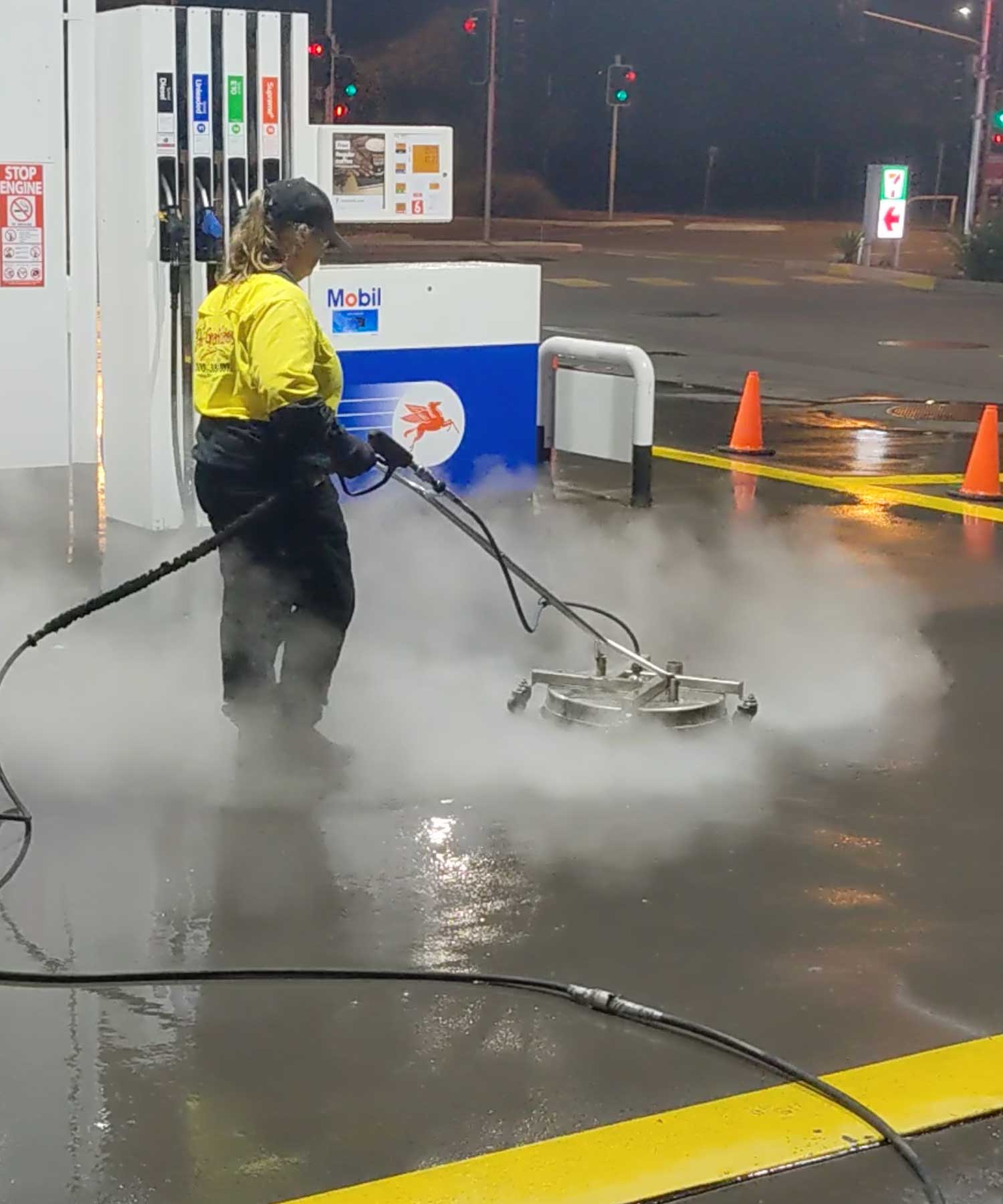
Hot water pressure washing follows the chemical treatment, removing the dissolved contamination across the full floor area. Hot water is significantly more effective than cold for industrial floor cleaning — the heat accelerates the breakdown of residual oil and grease contamination and improves the penetration of the cleaning process into the surface texture of the concrete. On a heavily contaminated floor, the difference between hot and cold water pressure washing is visible in the result — hot water produces a substantially cleaner surface from a single pass, reducing the number of treatment cycles required and the overall time on site.
Spin jet units are deployed for large floor areas, providing consistent, high-coverage cleaning across the full surface without the streaking and uneven coverage that a standard pressure washing lance produces over large areas. The spinning action of the jets delivers even pressure distribution across the treatment zone, producing a uniform clean result across the full floor area efficiently — which matters significantly when the floor being cleaned is measured in hundreds or thousands of square metres.
Wastewater management is a standard consideration on every factory floor cleaning job. Contaminated wastewater is vacuum recovered on site where site conditions allow, preventing it from entering stormwater drains and ensuring the job is completed in compliance with environmental regulations. The equipment required for vacuum wastewater recovery is part of our standard setup for industrial floor cleaning jobs, and wastewater management is planned as part of the job scope from the outset rather than treated as an afterthought.
Interior wall cleaning is available as part of the same visit for facilities where internal walls have accumulated cobwebs, soot, oil residue, and dust — addressing the full working environment rather than just the floor surface, and making a measurable difference to light levels and overall workspace condition.
Scheduling Around Your Operations
For operating warehouses and workshops, the practical challenge of floor cleaning is not just the cleaning itself — it is fitting the work into the operational schedule of a facility that cannot simply stop for a day while the floor is treated.
The Stain Eaters team is set up to work around operational schedules in whatever configuration the facility requires. After-hours and weekend cleaning is the most common approach for facilities with standard weekday operating hours — the cleaning is completed outside trading hours and the facility is ready for normal operations the following morning. For larger facilities or those with extended operating hours, staged cleaning across sections of the building — treating one area at a time while operations continue in the remainder — allows the work to be progressed without shutting down the facility entirely.
Our vehicles arrive fully self-contained with everything needed on board — cleaning solutions, hot water equipment, spin jet units, and wastewater recovery systems — so we are not relying on your facilities or creating additional disruption to your operation. The setup and pack-down process is managed efficiently, and the footprint of our team on your site is kept to what is necessary to complete the job.
For facilities where floor cleanliness is a regulatory or operational requirement — food production, pharmaceutical, logistics, and automotive environments in particular — scheduled professional cleaning at regular intervals is the most practical and cost-effective approach. Regular cleaning prevents contamination from building up to the levels that require intensive remediation, protects the floor coating beneath, and ensures the facility is consistently in a condition that reflects the standards of the business.
The Floor as a Business Asset
It is worth stepping back from the operational detail to make a broader point about how warehouse and workshop floors deserve to be thought about in a business context.
The floor of an industrial facility is one of the largest single assets in the building. It is the surface that every piece of equipment, every vehicle, every pallet, and every person in the facility relies on every day. Its condition affects safety, operational efficiency, and the longevity of the floor coating system that protects the concrete beneath. And its appearance communicates something about the business to everyone who walks into the facility.
A professionally maintained floor that is consistently clean, with legible line markings and no embedded contamination, is a floor that is doing its job properly — as a safe working surface, a compliant operational environment, and a presentable representation of the business. A floor that has been allowed to accumulate years of oil, grime, and tyre marking is none of those things — and restoring it is always more effective, less costly, and better for the facility in the long run than allowing the deterioration to continue.
If your warehouse, workshop, or industrial facility floor is due for a professional clean — whether that is a first-time treatment of a floor that has never been properly cleaned, or a scheduled maintenance clean as part of an ongoing program — get in touch with The Stain Eaters team today for a free assessment.