
Why Tyre Marks Stick: the science of rubber transfer on concrete
Black arcs on a driveway, scuffs across a loading bay, “shadows” that won’t budge in a car park—tyre marks aren’t just dirt. They’re a thin film of rubber and road grime that has fused to the surface.
What tyre marks are made of
Modern tyres blend synthetic rubbers (mainly SBR), natural rubber, carbon black for strength and colour, resins and plasticisers. Under friction, heat and pressure, a microscopic layer of this compound is sheared from the tyre and smeared onto the pavement along with dust, oils and fine metals from the road.
Why concrete grabs the mark
Concrete is not smooth. It has:
- Micro-texture and roughness that abrade the tyre surface.
- Porosity—open capillaries and tiny voids that absorb plasticisers, oils and pigment.
- Alkalinity that interacts with some compounds, helping the residue cling.
Add a hot day, tight steering or hard braking and you get thermal softening of the rubber. The result is a film that partially wets into the pores, then cools and locks on. Cold water and scrubbing usually spread the plasticisers and can leave a paler “ghost” that looks even worse.
Why some areas are worse than others
Entry/exit lanes, turning circles, ramps and tight parking bays concentrate shear forces. Fresh line marking can also attract scuffs until fully cured. Inside warehouses, forklift tyres leave similar polymer transfers, often mixed with carbon dust.
How we release tyre marks (without scarring the surface)
At The Stain Eaters, we pair surface science with the right method so the mark is released—not driven deeper.
- Identify & test. We confirm the substrate (concrete, pavers, coated surfaces), check for sealers/curing compounds and run small patch tests.
- Treatment first. Technicians apply specialist cleaning solutions formulated to soften rubber films and mobilise plasticisers without etching or bleaching the surface. Dwell times are controlled to suit the contamination and material.
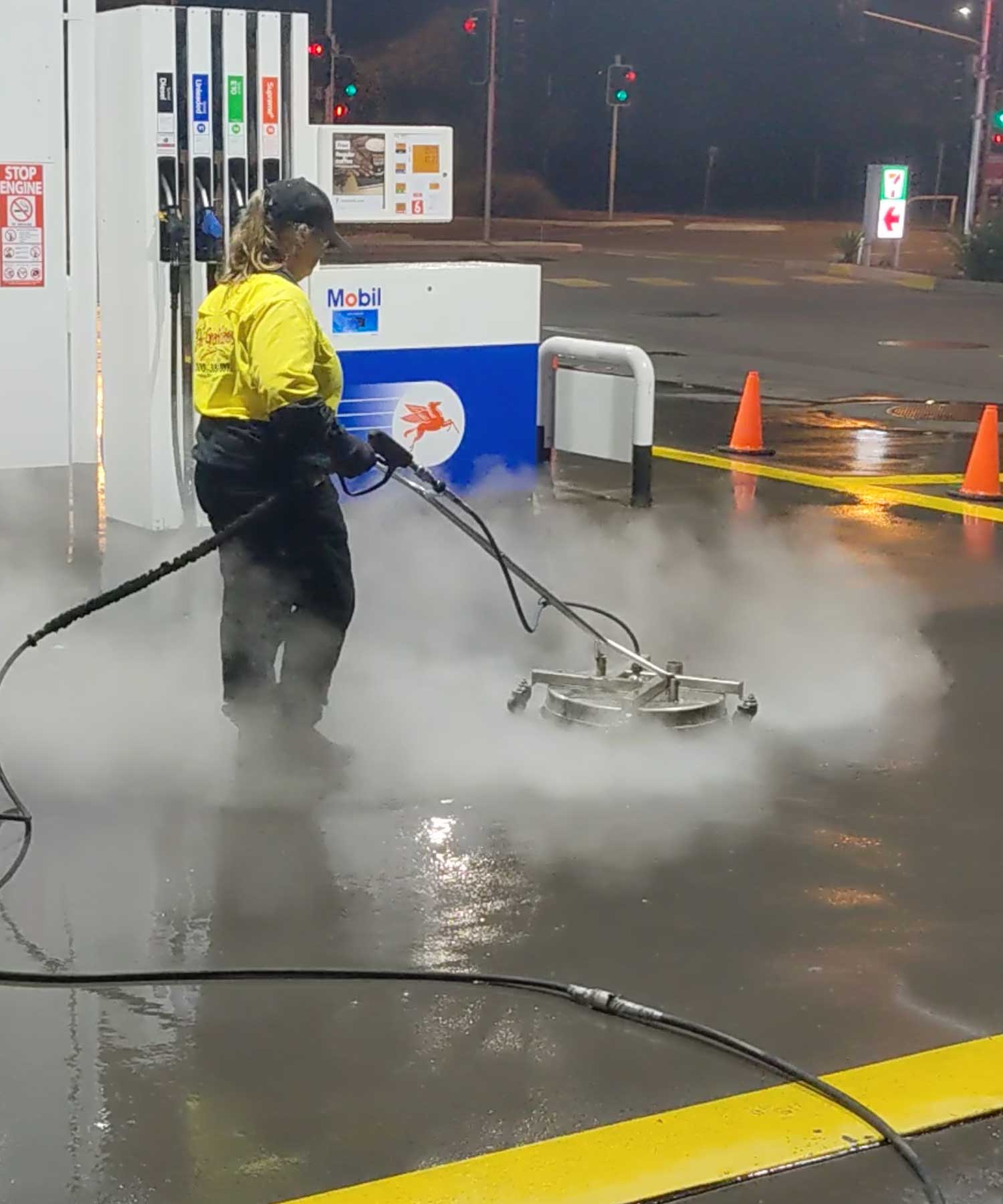
- Flush the pores. Once the film is released, we use our custom-built pressure washing systems to deliver hot-water under controlled pressure, carrying the residue out of the surface texture so the area dries clean and even.
- Final clean. Stubborn shadows are re-treated locally for a uniform result. Where required, we divert and capture wash water for responsible disposal and schedule around trading to minimise disruption.
DIY pitfalls to avoid
- Solvents can drive plasticisers deeper or dull coatings.
- Aggressive blasting can bruise the concrete cream and leave permanent stripes.
- Acid washes do little for rubber films and can roughen the surface, making future soiling faster.
Prevention tips
- Avoid tight turning on hot days where possible.
- Keep bays swept—dust acts like glue for rubber films.
- Allow new line marking and fresh concrete adequate cure before heavy use.
- Consider a compatible protective sealer or coating in high-wear areas (we can advise).
- Set a periodic clean to remove early transfer before it hardens.
If tyre marks have taken the edge off your presentation, we’ll get them off—and bring back a consistent finish.