
Why Rain Makes Driveways So Dirty
You wake up the morning after a big storm, step outside to check the damage, and there it is — your once-clean concrete driveway now looks like a modern art installation gone wrong. Streaks of rust-red and muddy brown run across the surface in every direction, and no amount of wishful thinking is going to wash them away on their own.
Sound familiar? You’re not alone. This is one of the most common calls we get at Stain Eaters after a heavy rain event, and there’s a very good reason it happens — one that a lot of property owners never even think about until they’re staring down at a very unhappy driveway.
So, What Actually Causes Those Stains?
Here’s the short version: it’s your soil. Specifically, it’s iron-rich soil doing what iron-rich soil does when it gets wet and goes for a ride.
During a heavy rain event, fast-moving water picks up topsoil from garden beds, verges, and embankments and carries it across hard surfaces like driveways, footpaths, and car parks. When that water slows down and eventually evaporates, it leaves behind a layer of sediment that’s locked itself into the porous surface of your concrete.
Now here’s where it gets particularly frustrating. Concrete is alkaline, and when iron-rich soil sits on it — especially while wet — a cleaning solution reaction kicks off. The iron in the soil oxidises (in plain English: it rusts), and that rust bonds to the concrete surface, creating those distinctive orange-brown stains you’re now looking at. The longer it sits, the deeper it sets.
This isn’t just a cosmetic issue, either. Over time, staining can obscure surface cracks, make slip hazards harder to spot, and give your property a neglected appearance that can affect its perceived value. For commercial properties, it can also reflect poorly on your business — because let’s be honest, nobody wants to walk into a professional building across a driveway that looks like a rust bucket.
Why a Garden Hose and a Scrub Brush Won’t Cut It
We hear it all the time: “I tried hosing it off but it didn’t do anything.” And that makes complete sense, because there are two problems with that approach.
First, dried dirt and rust staining on concrete isn’t sitting on the surface — it’s in the surface. Concrete is porous, and fine particles of iron-laden sediment get drawn into those pores during the drying process. A standard hose doesn’t generate enough pressure to dislodge them, and a scrubbing brush alone won’t break the cleaning solution bond that rust has formed with the concrete.
Second, the wrong cleaning approach can actually make things worse. Using harsh acids without the right dilution, applying bleach to rust stains, or going at the surface aggressively without the right equipment can damage the concrete finish permanently — and that’s a much more expensive problem than the original stain.
The Stain Eaters Approach: Hot Water, Controlled Pressure, and Specialist Chemistry
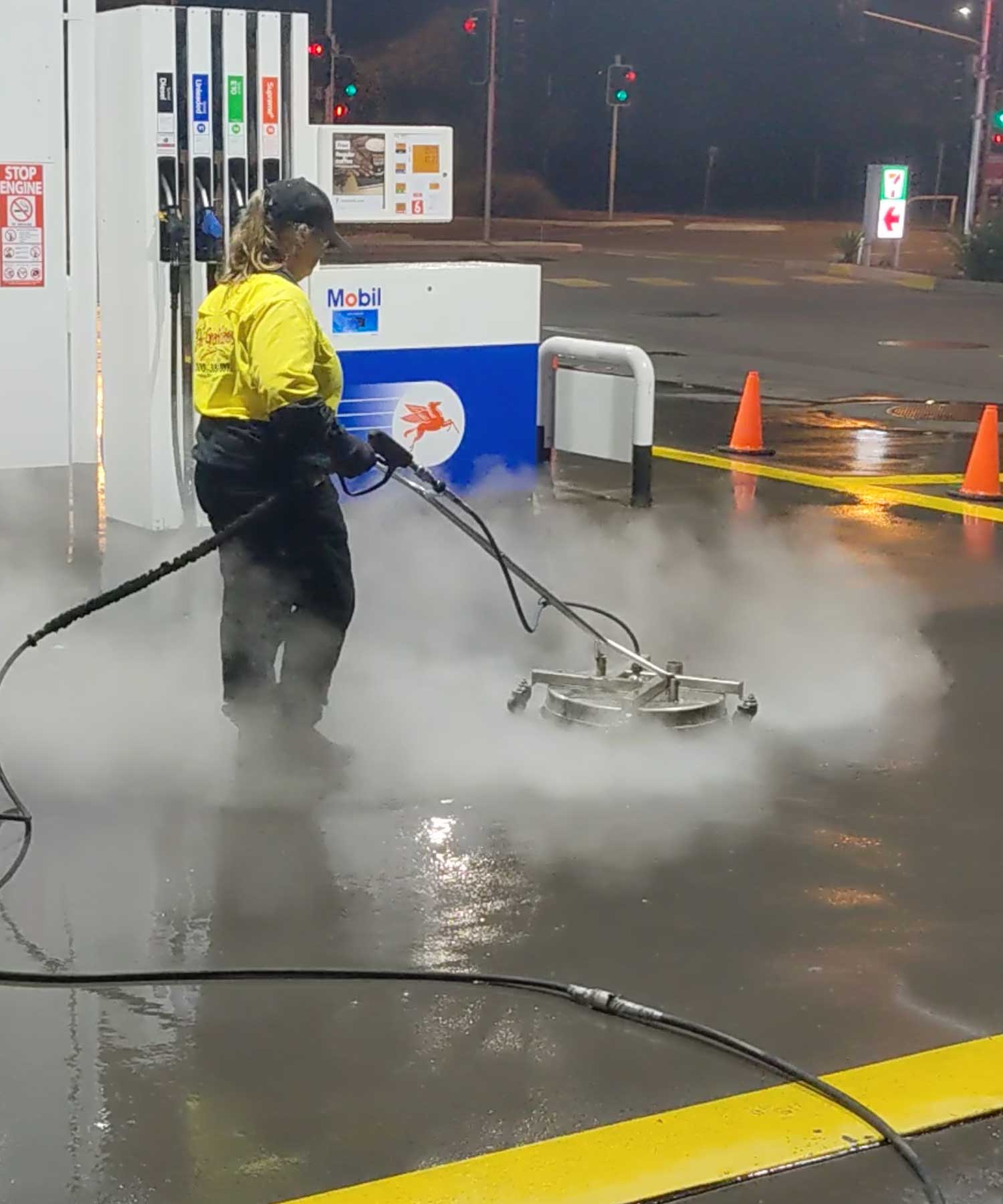
This is where professional pressure washing — done properly — makes all the difference. At Stain Eaters, our technicians don’t just turn up with a pressure washer and hope for the best. There’s a real science to what we do, and it’s tailored specifically to the type of staining your surface is dealing with.
Hot Water Pressure Washing
Cold water pressure washing has its place, but for dirt, embedded sediment, and rust-stained concrete, hot water is a game changer. Heat breaks down the bonds between contaminants and the concrete surface far more effectively than cold water alone, allowing us to lift material that would otherwise require far more aggressive cleaning solution treatment. Our hot water systems also penetrate deeper into the pores of the concrete, flushing out fine particles that cold water simply pushes around. The result is a more thorough clean that lasts longer.
Controlled Pressure — Because More Isn’t Always Better
One of the biggest mistakes DIYers make with pressure washing is cranking the pressure up as high as it’ll go. Too much pressure on concrete — especially older or decorative surfaces — can etch the finish, open up existing micro-cracks, and actually make future staining worse by increasing porosity. Our technicians calibrate pressure based on the specific surface they’re working on. A freshly poured residential driveway needs a very different approach to a commercial car park with years of weathering behind it. Getting that balance right is what protects the surface while still delivering a result that actually impresses.
Specialist Rust and Stain Treatment Solutions
For rust staining specifically — the kind caused by iron-rich soil after a rain event — pressure washing alone isn’t enough. The rust has cleaning solutionly bonded with the concrete, and it needs to be cleaning solutionly broken before it can be mechanically lifted.
Our technicians apply professional-grade rust treatment products formulated specifically for use on concrete. These solutions work by targeting the iron compounds and breaking them down at a molecular level, lifting the stain from within the concrete pores rather than just bleaching the surface. The result is a genuine clean, not a disguised one.
Depending on the severity of the staining, we may apply pre-treatment, allow appropriate dwell time, and then follow up with hot water pressure washing to flush everything clear. For particularly stubborn or large-scale rust staining — common on commercial driveways and car parks — we may carry out multiple treatment passes to achieve the best possible result.
Residential vs. Commercial: Same Problem, Different Scale
Rain-driven rust and dirt staining is equally unforgiving whether you’re a homeowner with a double-width driveway or a business owner managing a multi-level car park. But the stakes — and the scale — are a little different.
For homeowners, the pain is personal. Your driveway is the first thing people see when they visit. It frames your home. A rust-stained concrete surface can make an otherwise well-kept property look tired and neglected, and if you’re thinking about selling, it can genuinely affect buyer perception.
For commercial property owners and managers, the impact is reputational and often financial. A stained entrance or car park sends a message to customers, clients, and tenants — and it’s not the message you want to be sending. In industries like hospitality, healthcare, and food service, the appearance of common areas and entrances is directly tied to perceived standards of cleanliness and professionalism.
Stain Eaters works across both residential and commercial environments. Our team is equipped to handle everything from a single residential driveway to large-format commercial hardscapes, and we can schedule work to minimise disruption to your day-to-day operations.
What Happens If You Wait?
This is worth saying plainly: the longer you leave it, the harder it gets.
Freshly deposited iron-rich sediment that’s still relatively new on the surface is far easier to treat than staining that’s been baking in the sun for weeks or months. Over time, the rust deepens its bond with the concrete, and what might have been a single-pass clean can become a multi-treatment job. That means more time, more product, and more cost.
If you’ve just had a significant rain event and you can see the telltale rust streaks forming, the best thing you can do is get in touch sooner rather than later. Even a quick enquiry can help you understand what you’re dealing with and what treatment is likely to involve.
Prevention: Is There Anything You Can Do?
Honestly? A degree of this is hard to avoid entirely if you live in an area with iron-rich soils and you’re going to get heavy rain events. But there are some things that can reduce the impact.
Concrete sealing is one of the most effective long-term strategies. A quality penetrating sealer applied to clean, dry concrete fills the surface pores and creates a barrier that makes it significantly harder for sediment and rust to bond. Stains still need to be cleaned when they occur, but they’re less likely to have set deeply, and the cleaning process is much easier.
Maintaining garden bed edging and barriers that prevent soil from washing onto hard surfaces also helps, as does ensuring your drainage is directing runoff away from concrete areas rather than across them.
And when the big storms do roll through — which they will — having a professional pressure washing team ready to respond means you can act fast and keep a manageable job from becoming a major one.
Get Your Concrete Looking Its Best Again
Whether you’re dealing with the aftermath of last night’s storm or you’ve been staring at those rust stains for longer than you’d like to admit, Stain Eaters is here to sort it out.
We bring the hot water, the controlled pressure, the specialist chemistry, and the know-how to get the job done properly — without damaging your surface in the process. Residential or commercial, small job or large site, we’ll assess what you’re dealing with and give you a straightforward plan to fix it.
Don’t let the rain have the last word on how your property looks. Get in touch with the Stain Eaters team today for a free assessment and let’s get that concrete looking the way it should.