Why Oil Stains on Forecourts Get Harder to Remove the Longer You Wait
Walk onto almost any petrol station forecourt that’s been trading for a few years and you’ll see it. Dark, set-in staining around the pump islands. A permanent-looking patch where tankers connect for deliveries. A general dinginess to the concrete that no amount of surface sweeping ever quite fixes. None of it happened overnight. It’s the result of months, sometimes years, of oil and fuel contamination being left to sit, layer on layer, without ever being properly addressed.
This is the part of forecourt maintenance that catches a lot of operators out. Contamination on a working forecourt doesn’t arrive as one dramatic spill that gets noticed and dealt with. It accumulates slowly, in the same locations, day after day, until what started as a light residue has become deeply set staining that’s genuinely difficult to shift. Understanding why that happens, and what it takes to reverse it, is the difference between a forecourt that stays in good condition and one that quietly gets worse every year it goes unmanaged.
Contamination Is Baked Into the Business Model
There’s no getting around this one. If you operate a fuel retail site, oil and fuel contamination isn’t an unfortunate exception to normal trading, it’s a direct and unavoidable consequence of what the site exists to do. Every fuel transaction carries some risk of drip, splash, or minor spill. Every vehicle that drives across the forecourt carries whatever is on its undercarriage. Every delivery tanker connection and disconnection has the potential to leave a mark on the surface beneath it.
None of this makes a forecourt operator careless or the site poorly run. It makes forecourt contamination a predictable, recurring feature of the business, the same way wear and tear is a predictable feature of any high-traffic commercial surface. What separates a well-maintained site from one that’s let it get away from them isn’t whether contamination appears, it’s whether it gets addressed before it has the chance to properly set in.
Why Contamination Gets Harder to Remove the Longer It’s Left
The trouble with treating forecourt contamination as something that can wait is that concrete doesn’t hold onto oil and fuel the way people assume it does. These substances don’t sit neatly on the surface waiting for a convenient moment to be addressed. They penetrate into the pore structure of the concrete from the moment they make contact, and the longer that process continues uninterrupted, the deeper the contamination goes.
A forecourt that’s cleaned regularly is dealing with contamination that’s still relatively shallow and manageable. A forecourt that’s gone months or years without proper attention is dealing with staining that’s had all that time to work its way progressively deeper into the surface. At that point, the contamination isn’t behaving like a mark that can be lifted off. It’s behaving like something that’s become part of the concrete itself, and full removal takes considerably more intensive treatment than it would have if the same contamination had been addressed early.
This is also where the appearance of the site starts working against the business rather than for it. A forecourt with dark, long-set oil staining around every pump island doesn’t read as a minor cosmetic issue to the customers driving in. It reads as a site that hasn’t been looked after in a long time, and for a fuel retailer competing on convenience and trust as much as price, that impression matters more than most operators give it credit for.
The Safety Conversation Nobody Wants to Have After an Incident
Beyond appearance, there’s a genuine safety dimension to long-term forecourt contamination that deserves more attention than it usually gets. Oil and fuel residue significantly changes how slip-resistant concrete is, particularly once it gets wet. A forecourt that’s accumulated years of untreated contamination can look perfectly normal on a dry day and become a serious hazard the moment it rains, when all that built-up residue turns the surface slick underfoot.
For a site with constant public foot traffic, moving between vehicles, the pump, and the store, that’s not a hypothetical risk. It’s a slip and fall incident waiting for the wrong combination of weather and timing. And it’s a genuinely avoidable one, provided the surface is being properly maintained rather than left to accumulate contamination over years between infrequent, reactive cleans.
There’s also a compliance dimension that sits alongside the safety one. Fuel retail sites carry ongoing obligations around how contaminated water is managed on site, including how oil and fuel residue is prevented from reaching stormwater drains during cleaning and general site runoff. This isn’t a once-off consideration that gets ticked off and forgotten. It’s a standing operational requirement that applies every time contaminated water moves across the site, which makes proper, responsible wastewater handling as much a part of forecourt maintenance as the cleaning itself.
Why This Needs to Be a Program, Not a One-Off Fix
The single biggest shift for any fuel retailer thinking about forecourt maintenance properly is moving from a reactive mindset to a scheduled one. Waiting years between cleans means every job is dealing with contamination that’s had the maximum possible time to set in, which makes each clean more intensive, more time-consuming, and ultimately more disruptive to trade than it needed to be.
A scheduled cleaning program flips that entirely. Regular, planned visits mean contamination never gets the chance to progress from shallow and manageable to deeply set and difficult, which keeps each individual clean faster and less disruptive to the site’s trading hours. It also means the forecourt maintains a consistently good standard of presentation, rather than slowly deteriorating year over year until someone finally decides it’s bad enough to warrant an intensive intervention.
For multi-site operators in particular, this is where a coordinated, ongoing maintenance relationship becomes genuinely valuable. Rather than each site individually deciding when contamination has become bad enough to warrant a call, a scheduled program applied consistently across a network keeps every site to the same standard, without relying on local judgement calls about when enough is enough.
Getting the Treatment Right, Every Time
Forecourt surfaces don’t respond to guesswork, and the type of contamination present, and how long it’s been building, varies from site to site and even from one section of the same forecourt to another. Fresh engine oil drip, long-set staining that’s penetrated deep into the concrete, diesel residue from tanker deliveries, and general grime buildup all behave differently and call for different treatment. Identifying what’s actually being dealt with, and how deeply it’s set in, is what determines whether a job produces a genuinely clean result or just a temporarily better-looking one.
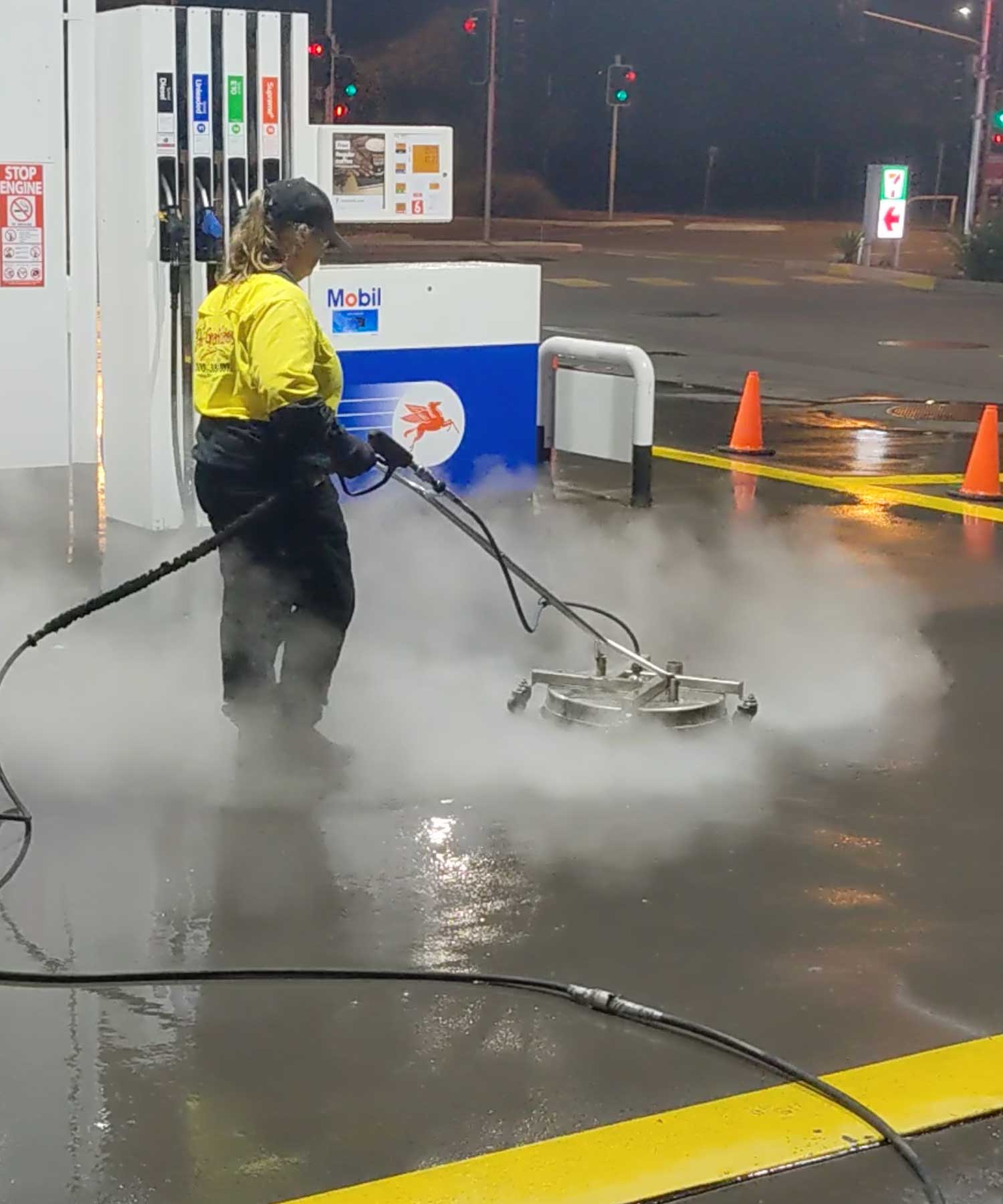
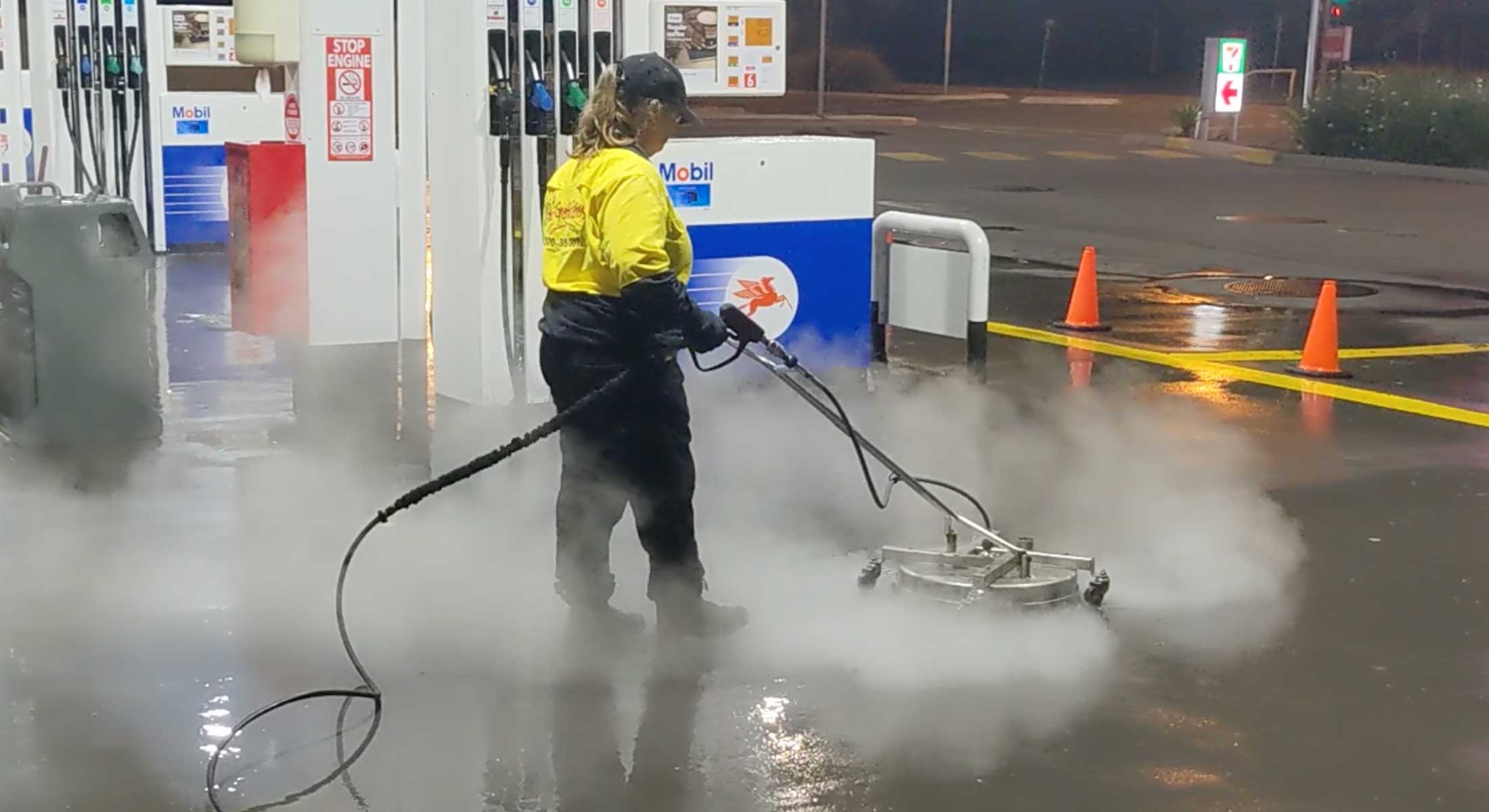
Getting a forecourt properly clean isn’t a matter of pointing a pressure washer at the problem and hoping for the best. It requires the right specialist cleaning solution matched to the contamination, applied with the dwell time needed to actually work rather than just sit on the surface, followed by hot water pressure washing to draw everything out properly. For long-set, deeply penetrated staining, this process may need to be repeated to achieve a full result. Skipping steps, or using the wrong approach for the type and age of contamination present, tends to produce a surface that looks temporarily better but still holds the underlying staining, which just means the same job needs doing again sooner than it should.
Wastewater capture is a non-negotiable part of that process too. Any water that’s been used to treat oil or fuel contamination needs to be properly collected and disposed of, not allowed to run off into stormwater drains. On a working forecourt, that means the cleaning process itself needs to be built around proper containment from the start, not treated as an afterthought once the job’s underway.
Keeping the Site Trading While the Work Happens
The other reality of forecourt cleaning that reactive, one-off approaches tend to overlook is that a fuel retail site can’t simply close for the day while maintenance happens. Customers still need to fuel up, the store still needs to trade, and any cleaning program needs to work around that rather than against it.
A properly planned approach means work can be staged around pump islands and high-traffic areas without shutting the whole site down, keeping the forecourt trading throughout. That’s a very different experience to the kind of intensive, disruptive clean that tends to be required once contamination has been left long enough that it’s worked its way deep into the surface, and suddenly the whole forecourt needs extensive treatment all at once.
Don’t Wait for It to Become a Bigger Job
The forecourts that stay looking good, stay safe, and stay compliant aren’t the ones that never see oil and fuel contamination. They’re the ones run by operators who address it consistently, before years of build-up turn a straightforward clean into an intensive restoration job.
If your forecourt has years of set-in staining that needs proper attention, or you’re looking to set up an ongoing maintenance schedule that keeps contamination from ever reaching that point again, get in touch with our team today for a free assessment.