
Why DIY Pressure Washing Graffiti Is Often the Worst Thing You Can Do
It makes complete sense as a first instinct. Graffiti appears on your wall, you have access to a pressure washer, and the logic seems straightforward — blast it off. Water under pressure removes dirt, cleans driveways, strips grime from all kinds of surfaces. Surely it will shift a graffiti tag.
The reality is more complicated, and in many cases, more damaging than the graffiti itself.
Cold water pressure washing applied directly to graffiti on porous surfaces like brick, concrete, render, and natural stone is one of the most common mistakes made in graffiti removal — by homeowners, by maintenance staff, and by well-meaning property managers trying to deal with vandalism quickly and cheaply. The result is frequently a problem that is significantly worse than the original tag, and in some cases, a problem that becomes permanent.
Understanding why requires a brief look at what graffiti actually is, how it interacts with porous surfaces, and what happens when you introduce high-pressure water without addressing the substance first.
What Graffiti Does to a Porous Surface
Spray paint — the most common graffiti medium — is a solvent-based coating designed to bond rapidly and durably to whatever surface it contacts. When it hits a porous surface like brick, concrete, render, or sandstone, it does not simply sit on top of the material. The solvents in the paint carry the pigment into the pores and voids of the surface, where it bonds as it cures. The depth of penetration depends on the porosity of the surface, the type of paint used, and how long it has been in place — but even relatively fresh spray paint on a porous surface has already begun the process of bonding below the surface level.
This is why graffiti on brick and concrete looks and feels different to, say, a splash of paint on a glass window. The glass is non-porous, so the paint sits entirely on the surface and can be removed with the right solvent and a clean cloth. The brick is porous, so the paint is partly in the surface — and removing it requires breaking that bond from within the material, not just wiping or blasting the surface layer.
Markers, paint pens, and other graffiti mediums behave similarly, though the specific chemistry of the pigment and carrier varies. What they share is the characteristic of penetrating porous surfaces to a degree that makes surface-only cleaning approaches ineffective.
What Cold Water Pressure Washing Actually Does
Here is where the pressure washer problem becomes clear.
When you apply cold water pressure washing to graffiti on a porous surface without first treating the paint with an appropriate specialist cleaning solution, the pressurised water hits the surface and does one of two things — neither of them what you want.
On the surface itself, the water disperses the outermost layer of paint, stripping some colour and creating the impression that the treatment is working. But beneath the surface, the pressure is actively driving the remaining paint pigment deeper into the pores of the material. The water penetrates the porous structure of the brick or concrete carrying dissolved and dispersed paint particles with it, pushing them further into the substrate than they would have reached through simple curing and adhesion alone.
The visual result is a ghost — a pale, washed-out version of the original tag that has been pushed into the surface rather than lifted from it. The colour intensity is reduced, but the staining is now deeper and more diffuse, spread through a larger area of the substrate. And paint that has been driven deeper into a porous surface by pressure washing is significantly harder to remove with professional treatment than paint that was simply allowed to cure naturally on the surface.
In some cases, it becomes impossible to remove fully. The pigment reaches a depth within the material where no surface-applied cleaning solution can adequately penetrate, and the ghost mark becomes a permanent feature of the surface. This is not a theoretical worst case — it is an outcome our technicians encounter regularly when attending jobs where a pressure washing attempt has been made before calling for professional help.
The second consequence of inappropriate pressure washing is physical surface damage. Excessive pressure applied to brick, concrete, render, and natural stone can abrade, erode, and scar the surface texture in ways that are irreversible without resurfacing or recoating. On older brick with softer face material, high-pressure water can strip the surface layer of the brick entirely, permanently altering its appearance and texture. On cement and acrylic render, it can cause furring and blow-outs that compromise the coating. On natural stone, it can erode fine surface detail and open up the pore structure in ways that make future staining and soiling worse.
That scarring remains visible long after the graffiti itself has been dealt with — a permanent reminder of the removal attempt that is often more visually disruptive than the original tag on an otherwise intact surface.
Why the Substance Has to Be Treated First
The correct approach to graffiti removal on porous surfaces starts not with water — hot or cold — but with a specialist cleaning solution targeted at the specific graffiti substance being removed.
The function of the specialist cleaning solution is to break down the bond between the paint or other graffiti medium and the surface material, working within the pore structure of the substrate to free the pigment and carrier from their bond with the surrounding material. Once that bond is broken, the loosened material can be lifted from the surface — either by hand cleaning or, where appropriate, by hot water pressure washing at controlled pressure.
Without that cleaning solution step, there is nothing to break the bond. Mechanical force — whether from a scrubbing brush or a pressure washer — can remove the surface layer of the paint but cannot address the bonded pigment within the pores of the material. That is why pressure washing alone produces the ghost result described above, and why the same surface treated with an appropriate specialist cleaning solution followed by controlled hot water pressure washing can come up clean.
The choice of specialist cleaning solution matters enormously. Different graffiti mediums — spray paints with different carrier solvents, alcohol-based markers, water-based paints — respond to different treatment formulations. A solution that effectively breaks down one type of graffiti medium may have little effect on another. Our technicians assess the graffiti medium and the surface type before selecting the appropriate solution, because getting that match right is what determines whether the treatment works.
Dwell Time: The Step That Cannot Be Rushed
Once the right specialist cleaning solution has been selected and applied, it needs time to work. That time — the dwell period — is when the solution penetrates the surface, interacts with the bonded paint, and breaks down the adhesion that is holding it in place.
Rushing the dwell time is one of the most common reasons DIY graffiti removal attempts with cleaning products fail or produce incomplete results. A solution applied and immediately wiped or rinsed away has not had adequate time to penetrate the pore structure of the material and work on the bonded pigment below the surface. The result is partial removal — the surface layer comes away, but the deeper bonded material remains, producing the same ghost effect as pressure washing, just through a different mechanism.
The appropriate dwell time varies depending on the surface type, the graffiti medium, the age of the graffiti, and the specific cleaning solution being used. Our technicians manage dwell time as a critical variable on every job, assessing how the solution is interacting with the surface and adjusting the treatment approach based on what they are seeing. It is a skilled judgement that comes from experience with a wide range of surfaces and graffiti types — not something that can be reliably replicated by following a product label in an unfamiliar situation.
When Pressure Washing Does Have a Role
Having spent considerable time explaining what cold water pressure washing does wrong, it is important to be clear that pressure washing absolutely has a legitimate and important role in professional graffiti removal — just not as the first or only step, and not with cold water at uncontrolled pressure.
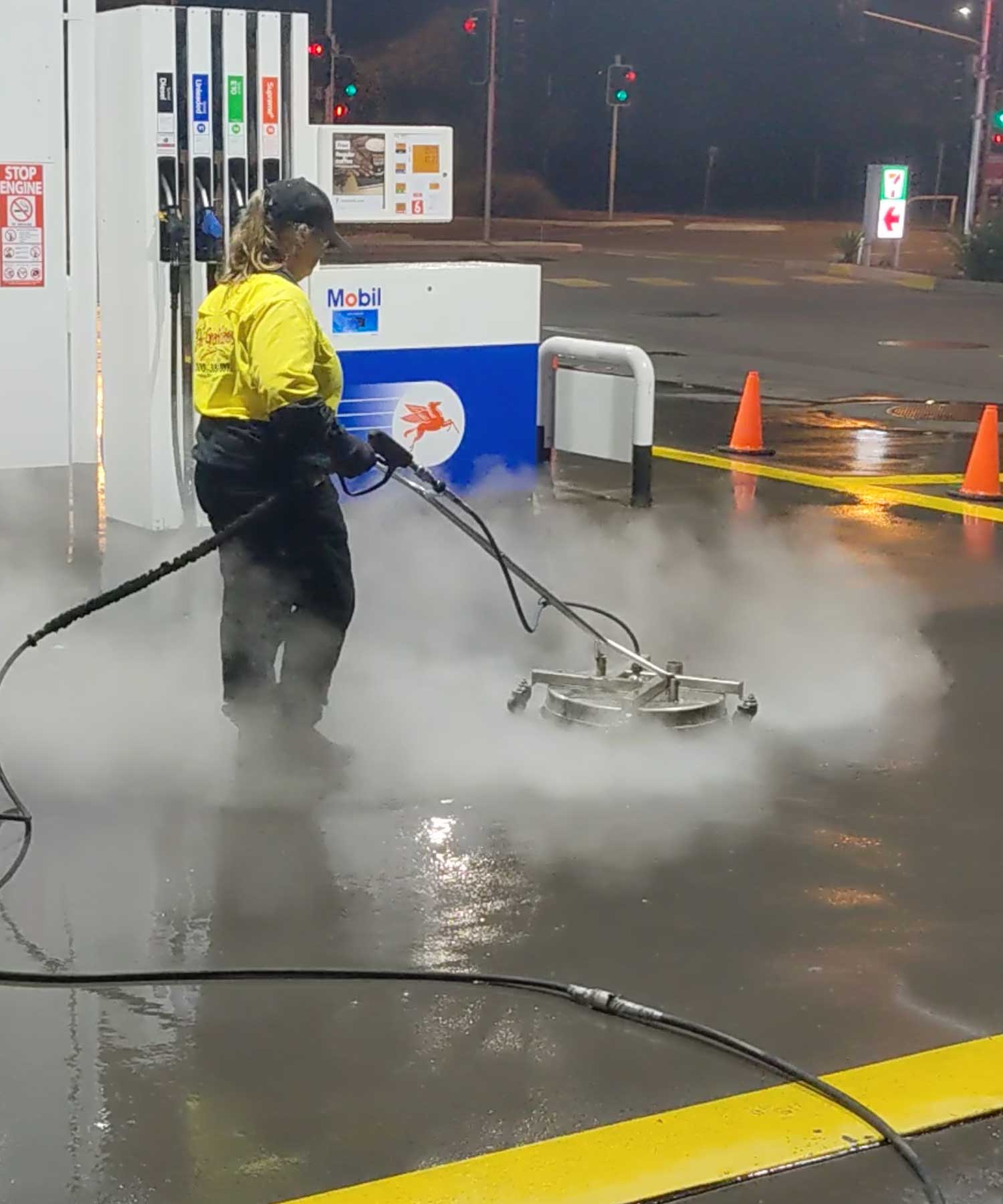
Hot water pressure washing, applied after appropriate specialist cleaning solution treatment and adequate dwell time, is one of the most effective tools available for flushing loosened graffiti material from porous surfaces. The combination of heat and pressure accelerates the final stage of removal, driving the broken-down paint out of the pore structure and flushing it clear of the surface. On brick and concrete surfaces that can tolerate the process, this combination of specialist solution treatment followed by hot water pressure washing produces thorough, complete removal that hand cleaning alone may not achieve on heavily painted or deeply penetrated surfaces.
The critical differences between this professional application and the DIY cold water pressure washing approach are the sequence, the temperature, and the pressure control.
Sequence matters because the specialist cleaning solution must do its work before any water pressure is applied. Introducing pressure before the bond is broken simply drives the paint deeper, as described above. The solution goes on first, dwells for the required time, and the pressure washing follows — not the other way around.
Temperature matters because hot water is significantly more effective than cold at completing the removal of broken-down paint residues from within porous surfaces. The heat assists in further softening paint residues, improves the penetration of water into the pore structure, and ensures a more thorough flush of the loosened material from the substrate. Cold water under the same pressure produces a noticeably less complete result on porous surfaces.
Pressure control matters because even after specialist solution treatment, excessive pressure can damage sensitive surfaces. Our custom-built equipment allows precise calibration of delivery pressure for the specific surface being treated — enough to achieve thorough removal of loosened material without causing the surface scarring that uncontrolled pressure produces. Different surfaces require different pressure settings, and getting that calibration right is as important as getting the solution and dwell time right.
For some surfaces and some graffiti situations, hand cleaning after solution treatment is the appropriate approach rather than pressure washing. Rendered walls, natural stone with delicate surface detail, and areas where pressure washing would risk water ingress into adjacent structures are all situations where careful hand removal following solution treatment produces the best outcome. Our technicians make that determination based on the surface, the environment, and what the job requires.
The Cost of Getting It Wrong
It is worth being direct about what is at stake when graffiti removal goes wrong, because it is not simply a matter of an incomplete result that can be improved with a follow-up attempt.
Graffiti that has been driven deeper into a porous surface by inappropriate pressure washing is harder to remove professionally — and in some cases, cannot be fully removed at all. The ghost mark that results from a failed pressure washing attempt may be permanent, requiring resurfacing, recoating, or in the case of brick, potentially panel replacement to fully resolve. Those are costs that dwarf the original cleaning job many times over.
Surface scarring from excessive pressure is similarly permanent. A brick face that has been eroded by high-pressure water cannot be restored to its original appearance without significant remediation work. Render that has been furred or blown out needs patching and recoating. Natural stone that has been abraded has lost surface detail that cannot be recovered.
The practical implication is straightforward: if graffiti has appeared on your property and you are considering a DIY removal attempt with a pressure washer, the risk of making the problem permanent or causing additional surface damage is real and significant. The cost of a professional removal job — done correctly, with the right solutions, the right dwell time, and the right equipment — is almost always less than the cost of rectifying a removal attempt that has gone wrong.
What to Do When Graffiti Appears
The most useful advice we can offer to anyone dealing with graffiti on their property is also the simplest: act quickly, but act correctly.
Speed matters because fresh graffiti is easier to remove than graffiti that has had days or weeks to cure and deepen its bond with the surface. The sooner professional treatment is applied, the better the result and the lower the cost. But speed without the right approach is worse than no action at all — a rapid pressure washing attempt that drives the paint deeper into the surface trades a solvable problem for a potentially permanent one.
If graffiti has appeared on your property — whether you manage a commercial building, a retail centre, a body corporate complex, or a residential property — the right first step is to contact a specialist removal team rather than reaching for whatever cleaning equipment is to hand. A professional assessment of the surface, the graffiti medium, and the appropriate treatment approach takes minutes, and it is the foundation of a result that actually resolves the problem rather than compounding it.
The Graffiti Eaters team is available to assess and treat graffiti on brick, concrete, render, natural stone, and a wide range of other surfaces, using specialist cleaning solutions and hot water pressure washing at controlled pressure to achieve complete removal without surface damage. Get in touch today for a free assessment.