
Why DIY Concrete Cleaning Often Makes Stains Worse
If you’ve ever looked at a grubby driveway or a stained path and thought, “I’ll just blast it with the pressure cleaner this weekend,” you’re not alone. Concrete feels tough, so it’s easy to assume it can take whatever you throw at it.
The problem is that a lot of DIY concrete cleaning doesn’t just fail to remove stains — it actually makes them worse. You can end up with visible lines, patchy colour, roughened concrete, and stains that are now deeper or more obvious than when you started. Then you’re stuck living with it… or paying to fix the damage.
Here’s why it happens, and how a professional approach avoids the common traps.
Concrete is tougher than you think — and more delicate than it looks
Concrete is strong, but its surface is also porous and textured. Stains don’t always sit neatly on top. Oils, tannins, rust, tyre marks, mould, and general grime can soak into the pores and bind to the surface.
When you hit that with uncontrolled pressure, the top layer of the concrete can be affected before the stain is properly broken down. That’s how you get that “clean but ugly” result — the stain isn’t fully removed, and the concrete surface is now uneven or etched, so it shows everything.
The most common DIY mistake: using pressure as the “cleaning cleaning solution”
Cheap pressure cleaners and high-pressure hoses can feel satisfying because you see dirt move. But pressure alone is a blunt tool. If the stain is bonded into the surface, blasting harder usually doesn’t lift it — it just damages the concrete around it.
You’ll often see:
- Wand marks and zebra striping where each pass overlaps differently
- Patchy, lighter sections where the surface has been etched or roughened
- Shadow stains that remain, but now stand out more because the surrounding concrete has changed colour
This is especially common on driveways, exposed aggregate, and older concrete where the top layer is already weathered.
The “too close, too slow” problem
Pressure washing is all about distance and speed. A small change in either can change the result dramatically.
When a DIY wand gets held too close, or moved too slowly over one spot, it can scour the surface. That leaves a lighter patch that looks like a permanent mark. People often keep going trying to “blend it in”, and that’s when a small area turns into a big, obvious problem.
Even if you don’t visibly damage the concrete, inconsistent technique can still leave a streaky finish that makes the area look worse than before.
Mixing the wrong products can lock stains in
Another common DIY issue is using whatever cleaner is on hand — or mixing products because “surely stronger is better”. Sometimes it creates a reaction that sets the stain, or it strips the surface while leaving the stain behind.
A classic example is trying to remove oil with degreaser only, then blasting. If the oil hasn’t been properly broken down and extracted from the pores, the pressure wash can spread it, leaving a larger shadow. Or tannin stains from leaves might fade slightly, but come back as the surface dries because the contamination is still in the concrete.
This is why professional cleaning is less about brute force and more about using the right treatment first.
Why professionals get better results without damaging the surface
The difference isn’t just “better equipment”. It’s the process.
A professional approach usually starts with identifying what the stain actually is — tyre marks behave differently to rust, and mould behaves differently to tannins. Then the stain is treated using specialist cleaning solutions chosen for that contamination and that surface.
That treatment stage matters because it breaks down the bond between the stain and the concrete, so you don’t need to overdo the pressure. Done properly, you’re lifting the stain out rather than trying to sandblast the surface around it.
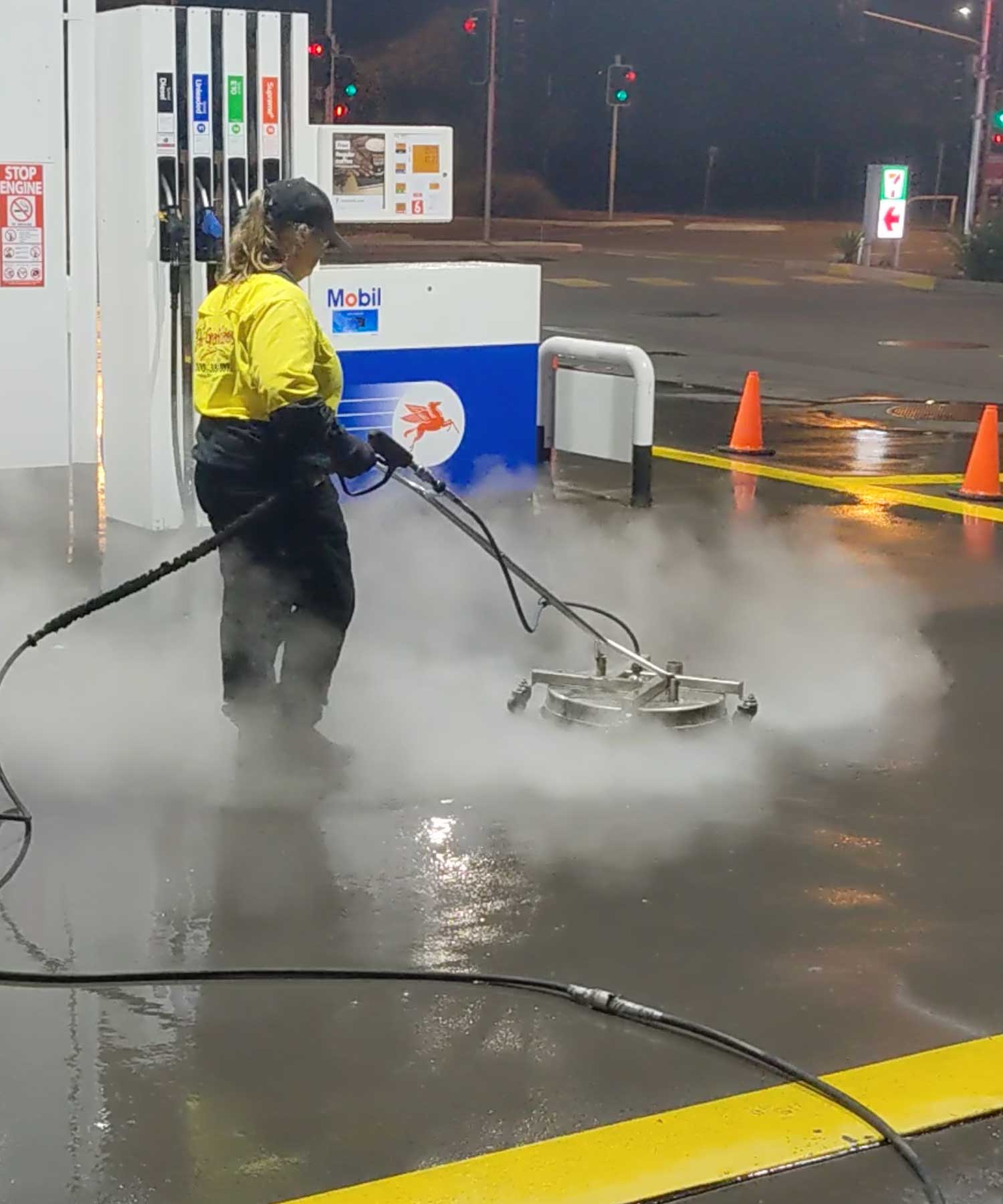
Once the stain is treated, the rinse and clean stage can be done more evenly and efficiently. For larger areas and stubborn build-up, we use our custom-built pressure washing systems to deliver hot-water under controlled pressure. The controlled pressure reduces the risk of etching and striping, while the heat helps break down grime and organic build-up more effectively than cold water alone.
How DIY cleaning creates permanent-looking “damage”
Most homeowners aren’t trying to damage their concrete. They’re trying to clean it. The problem is that concrete damage often looks like staining.
Etching, scouring and surface roughening change how the concrete reflects light. That’s why it can look “whiter” or “chalky” in patches, even though it’s technically clean. Once that top layer is affected, you can’t simply rinse it away. It may need re-grinding, resurfacing, or sealing to improve the appearance.
That’s a costly outcome from a job that started as a weekend clean-up.
When it’s worth calling in a professional
If you’ve got light dust and general dirt, DIY cleaning can be fine. But if you’re dealing with stains that have been sitting for months or years — oil spots, tyre marks, leaf tannins, rust runs, black grime build-up, or recurring mould — the risk of making it worse goes up quickly.
It’s also worth getting help when you’re cleaning near surfaces you don’t want to damage, like painted walls, exposed aggregate, pavers, or decorative finishes where patchiness will stand out.
Professional cleaning is often quicker than people expect, and it can save you from the expensive “I made it worse” fix later.
A safer way to get your concrete looking good again
If you want your driveway, paths, patios or pool surrounds looking clean without the streaks, scouring, or patchy results, the key is treating stains properly and cleaning with control.
Our technicians remove stubborn stains using specialist cleaning solutions and proven methods, then clean efficiently and evenly using our custom-built pressure washing systems to deliver hot-water under controlled pressure when the job calls for it.