
There’s a Better Way to Remove Line Markings Than Grinding Them Out
Line marking paint has a job to do. It organises traffic, defines pedestrian zones, allocates parking bays, designates loading areas, and keeps people and vehicles moving safely and efficiently through commercial and industrial spaces. When it is doing that job well, nobody thinks about it much. It is just part of the environment.
The problems start when those markings need to change.
Car park layouts get reconfigured as tenancy arrangements shift. Warehouse and factory floor plans are redesigned to accommodate new equipment, new processes, or new safety requirements. Loading zones move. Disabled parking bays are relocated to comply with updated accessibility standards. Line markings that have been in place for years fade and wear to the point where they are no longer legible and need to be properly removed before fresh markings can be applied effectively.
In all of those scenarios, the question is the same: how do you get rid of the existing paint? And the answer that most people default to — mechanical grinding — is not always the right one. In fact, for most surfaces and most situations, it is the most damaging and most disruptive option available.
The Problem With Grinding
Mechanical grinding is the traditional approach to line marking removal, and it has been the default for a long time simply because it works in a basic sense — it removes the paint. But the way it removes it is where the problems begin.
A grinding machine works by abrading the surface — using rotating cutting heads or abrasive discs to physically cut away the layer of material that carries the paint. On concrete, that means cutting into the concrete surface itself. On asphalt, it means disrupting the bitumen matrix. In both cases, the machine does not distinguish between the paint it is trying to remove and the surface beneath it. It removes both, leaving behind a scarred, roughened channel where the line marking used to be.
Those grinding scars are not subtle. They are immediately visible — darker in colour than the surrounding surface, with a different texture that catches light and shadow in a way that makes the removal path obvious even from a distance. On a freshly sealed or well-maintained surface, grinding scars can be more visually disruptive than the original line marking. On a car park that is being reconfigured rather than fully resurfaced, those scars remain visible through the new line markings painted over them, creating a layered palimpsest of old layouts that undermines the clean, professional appearance the reconfiguration was meant to achieve.
There is also a structural dimension to the damage that grinding causes. Concrete and asphalt surfaces derive part of their durability from surface integrity — the smooth, dense surface layer that resists water penetration, cleaning solution attack, and physical wear. Grinding disrupts that layer, creating a roughened surface that is more porous, more vulnerable to water ingress, and more susceptible to ongoing deterioration. On external surfaces exposed to Australian weather conditions, that vulnerability has real consequences for the longevity of the surface.
And then there is the practical reality of grinding as a process. It is slow, labour-intensive, and noisy. It generates significant quantities of fine dust and debris that require management and containment — a particular challenge in occupied car parks, active warehouses, and retail environments where disruption to normal operations needs to be minimised. The equipment is heavy and not easily manoeuvred in tight spaces or around fixed obstacles. And for large areas of line marking removal, the time and labour costs add up quickly.
A Safer Approach: Specialist Cleaning Solutions and Hot Water Pressure Washing
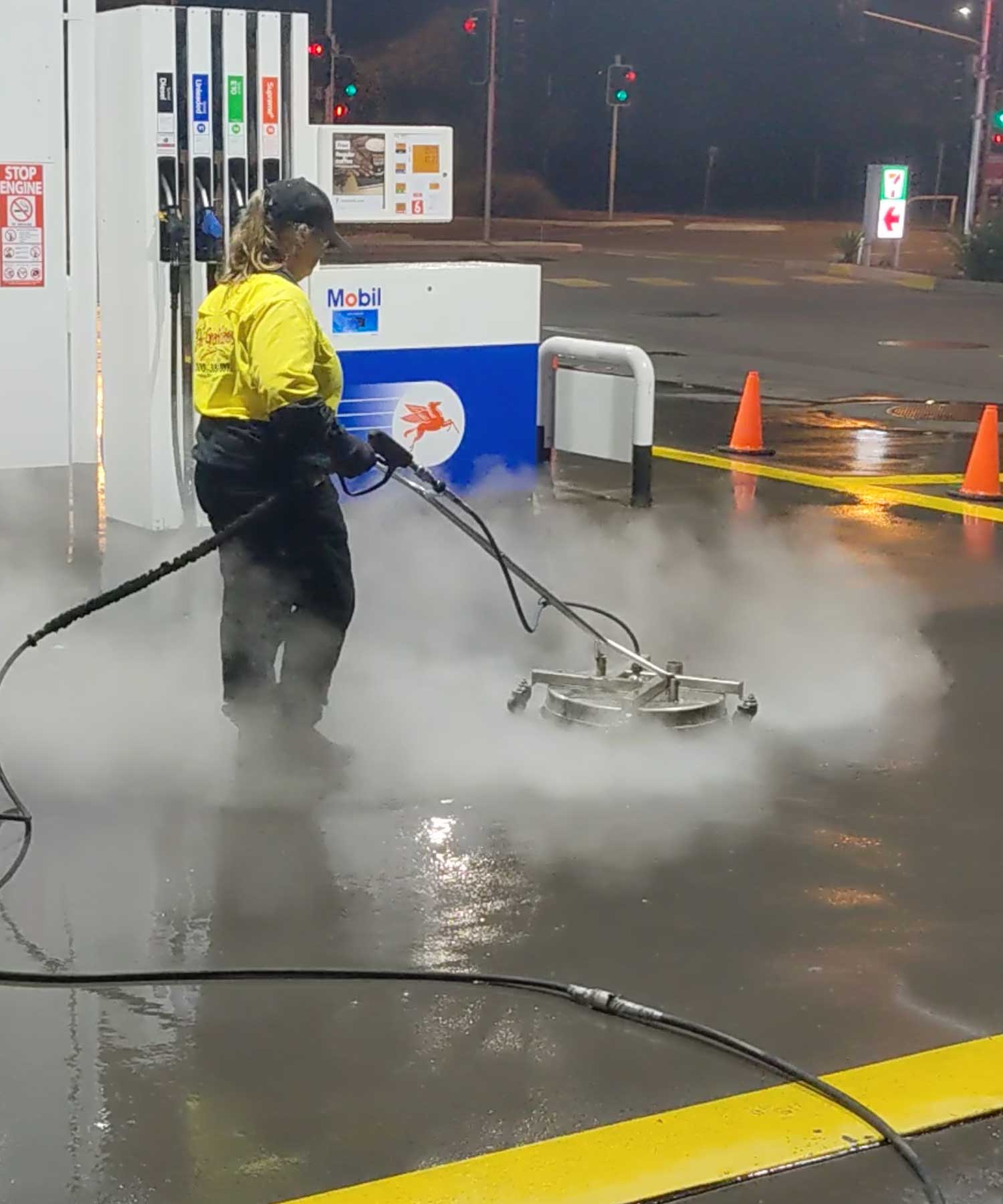
The Graffiti Eaters approach to line marking removal takes a fundamentally different starting point. Rather than attacking the surface mechanically to remove the paint, we work on the paint itself — using specialist cleaning solutions to break down the paint’s bond with the surface, combined with hot water pressure washing to lift and flush it cleanly away.
The process begins with the application of a specialist cleaning solution selected for the specific type of line marking paint being removed. Line marking paint is not a single category of product — it includes water-based traffic paints, solvent-based formulations, thermoplastic materials, and epoxy coatings, each of which has different cleaning solution properties and responds to different treatment approaches. Our technicians assess the paint type before selecting the appropriate solution, because the right match between cleaning solution and paint type is what makes the process effective.
Once applied, the cleaning solution is allowed to dwell on the surface for the time required to penetrate and break down the paint. Dwell time is a critical variable in this process — too short and the solution has not had adequate time to work through the paint layer fully, resulting in an incomplete removal that requires follow-up treatment. The right dwell time, managed by experienced technicians who can read how the solution is interacting with the paint, is what produces a thorough result efficiently.
With the paint broken down by the cleaning solution, hot water pressure washing completes the removal. The combination of heat and pressure lifts the loosened paint from the surface and flushes it away, leaving the substrate clean and intact beneath. The hot water delivery is a significant part of what makes this process effective — heat accelerates the breakdown of paint residues and ensures that the flushing action is thorough rather than superficial.
The result is a surface that is genuinely free of line marking paint, with the substrate completely undamaged. No grinding scars. No surface disruption. No change to the texture or integrity of the concrete or asphalt beneath the markings.
Why Surface Integrity Matters
It is worth pausing on the surface integrity point, because it is the most significant practical advantage of the cleaning solution and hot water approach over mechanical grinding — and it has implications that go beyond aesthetics.
For external concrete surfaces — car parks, hardstands, loading docks, pedestrian areas — surface integrity is directly related to longevity. A surface that has been ground develops a more porous, roughened texture that accelerates wear, allows water to penetrate more readily, and creates pathways for the freeze-thaw cycling and cleaning solution attack that cause long-term surface deterioration. In Australian conditions, where UV exposure and temperature variation are significant, that accelerated deterioration is a real cost that does not show up immediately but accumulates over the life of the surface.
For internal concrete floors in warehouses and factories, surface integrity matters for different reasons. Internal floors are often subject to forklift traffic, pallet movement, and significant point loads that depend on the structural consistency of the surface layer. Grinding creates channels of weakness in that layer — areas where the surface is thinner, more porous, and more vulnerable to the mechanical stresses of industrial use. Over time, those channels can develop into cracking and spalling that requires more extensive remediation.
For asphalt surfaces, grinding is particularly problematic because asphalt’s durability depends on the dense, compacted surface layer that forms during laying and sealing. Disrupting that layer exposes the coarser aggregate beneath, creating a rougher, more porous surface that is vulnerable to water penetration and the ravelling that follows. On external asphalt car parks, grinding scars are a common starting point for larger areas of surface distress.
The cleaning solution and hot water process preserves all of that. The surface comes through the treatment exactly as it went in — texture, density, and structural integrity intact. For property managers and facilities operators thinking about the long-term condition of their assets, that preservation is not a minor detail. It is a meaningful difference in the lifecycle cost of the surface.
Speed, Cost, and Disruption: The Practical Advantages
Beyond surface preservation, the cleaning solution and hot water approach offers practical advantages over grinding that matter in real operational contexts.
Speed is one of the most significant. Hot water pressure washing covers ground considerably faster than mechanical grinding, which is a slow, pass-by-pass process that moves methodically along each line marking. For large areas of line marking removal — a multi-level car park being reconfigured, a large warehouse floor being re-laid out — the time saving is substantial. Faster completion means less disruption to the operation of the facility and a quicker turnaround to the point where new line markings can be applied.
Cost follows from speed. A process that completes faster with less labour-intensive equipment is a more cost-effective process, and that efficiency is reflected in the price of the service. For commercial operators managing maintenance budgets across a property portfolio, the cost difference between grinding and hot water pressure washing for line marking removal is a meaningful one — particularly on larger jobs where the gap widens with scale.
Disruption management is another area where the hot water process has clear advantages. The process does not generate the dust and debris that grinding produces, which significantly simplifies the management of occupied or active environments. A car park that needs to remain partially operational during line marking removal can be managed in zones without the dust containment requirements that grinding demands. A warehouse that cannot afford extended downtime can have sections treated and cleared efficiently without the extended setup and cleanup that mechanical removal requires.
The equipment is also more manoeuvrable in complex or constrained environments. Tight car park bays, narrow internal aisles, and areas around fixed infrastructure that would challenge a grinding machine are readily accessible with pressure washing equipment, allowing line markings in awkward locations to be addressed without compromise.
When Line Markings Need to Go
The scenarios where line marking removal becomes necessary are more varied than they might first appear, and they come up more regularly in the management of commercial and industrial properties than most people anticipate.
Car park reconfiguration is perhaps the most common trigger. As tenancy arrangements change, accessibility requirements evolve, or simply as the original layout proves less than optimal in practice, car parks are reconfigured with surprising frequency. Each reconfiguration requires the old layout to be cleanly removed before the new one can be applied — and the quality of the removal directly affects the legibility and appearance of the new markings.
Zone changes in warehouses and factories are equally common. As production processes change, equipment is replaced or relocated, and storage configurations evolve, the floor marking system that organised the original layout needs to be updated. In safety-critical environments where floor markings define pedestrian corridors, forklift routes, and hazard zones, the clarity of the marking system matters — and that clarity depends on old, redundant markings being properly removed rather than painted over.
Faded and worn line markings present a different kind of removal challenge. Paint that has worn to a ghost of its original self is often best fully removed and replaced rather than painted over, because applying fresh paint over partially worn markings produces an uneven result that looks worse than either the worn original or a clean fresh application. A proper removal and reapplication produces a result that is both more professional in appearance and more durable in performance.
Choosing the Right Removal Partner
Line marking removal is a job that rewards getting right the first time. A poor removal — whether through grinding that scars the surface or an incomplete cleaning solution treatment that leaves paint residue behind — creates additional work and cost that compounds the original task.
The Graffiti Eaters brings specialist cleaning solutions, custom-built hot water pressure washing equipment, and technicians experienced in managing the dwell time and treatment variables that produce a thorough, surface-safe result across concrete and asphalt surfaces in commercial, retail, and industrial environments.
If you are planning a car park reconfiguration, a warehouse floor re-layout, or simply need existing line markings removed cleanly and efficiently, get in touch with our team today for a free assessment.