
The Real Reason Oil Stains on Concrete Are So Hard to Remove
There is a moment that most homeowners and property managers are familiar with — the discovery of an oil stain on concrete. Maybe it is a fresh drip from a vehicle parked in the driveway. Maybe it is a spill in the garage that happened while changing oil and spread further than expected. Maybe it is a slowly accumulating dark patch in a car park that has been quietly growing for months. Whatever the source, the instinct is the same: reach for something to clean it up.
And this is where the problem frequently gets worse.
The household cleaner, the supermarket degreaser, the dish soap and hot water — these are the tools most people reach for first, and they are the tools most likely to turn a manageable oil stain into a deeply embedded, potentially permanent one. Understanding why requires a brief look at what concrete actually is, what oil does when it contacts a porous surface, and why the cleaning products that work perfectly well in a kitchen sink are fundamentally unsuited to the physics of concrete stain removal.
What Concrete Actually Is — and Why It Absorbs Everything
Concrete looks solid, dense, and impermeable. In most practical respects it is — you can walk on it, park on it, and load it with substantial weight without it deforming. But at a microscopic level, concrete is a porous material. It is full of tiny interconnected voids, channels, and capillaries — the spaces between cement particles, aggregate, and the byproducts of the curing process — that collectively give it a surface structure more like a very hard sponge than a sealed, impermeable barrier.
The degree of porosity varies between different types of concrete. A freshly placed, well-compacted, and properly cured concrete slab is less porous than an older slab that has been exposed to years of weather, thermal cycling, and mechanical loading. A textured or broom-finished surface has more exposed surface area than a smooth-trowelled finish. A concrete driveway that has never been sealed is significantly more absorbent than one with a penetrating sealer filling its surface pores.
But all unsealed concrete — and most concrete that has not been recently sealed — absorbs liquids to some degree. And oil is a liquid that exploits that porosity with particular efficiency.
How Oil Penetrates Porous Concrete
When oil contacts a porous concrete surface, it does not simply sit on top waiting to be wiped up. It begins moving into the surface almost immediately, driven by capillary action — the same physical process that draws water up through a paper towel or into a sponge. The tiny interconnected channels in the concrete create a capillary network that draws the oil inward, and the low viscosity of many oils — particularly at ambient temperature on a warm Australian day — allows them to flow readily into those channels and penetrate deeply into the surface.
The speed of penetration depends on several variables — the type and viscosity of the oil, the temperature of both the oil and the surface, the porosity of the concrete, and how long the oil is in contact with the surface before any intervention. Fresh engine oil on a warm concrete driveway in summer can penetrate several millimetres into the surface within minutes. Older, thinner oil — hydraulic fluid, diesel fuel, or gearbox oil that has degraded — penetrates even faster because its lower viscosity allows it to flow into smaller capillaries more readily.
As the oil penetrates, it carries pigmentation and combustion byproducts with it — the darker components of used motor oil, carbon particles from diesel, and cleaning solution breakdown products from hydraulic and transmission fluids — depositing them progressively deeper into the concrete as penetration continues. The stain you see on the surface is only the most visible part of a contamination profile that extends into the body of the concrete, becoming less concentrated but more diffuse with depth.
This is why the clock matters so much with oil stains. Every minute the oil sits on an unsealed concrete surface, it is moving deeper. What is addressable in the first minutes of a spill becomes progressively harder to treat as penetration deepens, and old, set oil staining that has had weeks or months to migrate and cure within the concrete pore structure presents a significantly more challenging removal problem than fresh contamination.
Why Different Oils Are Different Problems
Oil is not a single substance, and the range of oil contamination types found on driveways, car parks, factory floors, and forecourts is wider than most people appreciate. That variety matters because different oils have different cleaning solution compositions, different viscosities, and different behaviour within the pore structure of concrete — and they respond to different treatment approaches as a result.
Engine and motor oil is the most common residential stain source and is a complex mixture of base oil and additive packages — detergents, dispersants, antioxidants, and wear inhibitors that accumulate breakdown products and combustion residue during use. Used motor oil carries significant quantities of carbon and metallic particles that contribute to the dark, persistent staining it leaves on concrete surfaces.
Hydraulic oil and transmission fluid are typically thinner and more penetrating than engine oil, entering concrete pore structures more rapidly and reaching greater depth before their movement slows. They are also often less visible in their early stages — lighter in colour than used motor oil — which means contamination can be more extensive than the surface stain suggests.
Diesel and fuel contamination presents a different challenge again. Diesel is a relatively thin, highly penetrating fluid that moves rapidly into concrete and also carries aromatic compounds that contribute to the characteristic staining and odour associated with fuel-contaminated surfaces. Forecourt surfaces at service stations and truck stops deal with diesel contamination as a constant and significant maintenance reality.
Carbonised oil — the hardened, polymerised residue left by oil that has been subjected to high heat, such as around engine components or on workshop surfaces near exhaust areas — is among the most resistant to removal. The heat-driven polymerisation process cross-links the oil molecules into a harder, more insoluble material that bonds to concrete surfaces with considerable tenacity and resists the treatment approaches that work on unpolymerised oils.
Our technicians identify the oil type before any treatment begins, because the selection of the appropriate specialist cleaning solution depends on matching the treatment chemistry to the specific contamination being addressed. A solution effective on fresh engine oil is not necessarily the right choice for carbonised residue or diesel contamination — and applying the wrong product reduces effectiveness and wastes the critical early treatment window.
Why Household Cleaners Don’t Work — and Often Make It Worse
This is the part that surprises most people, because it runs counter to the intuitive logic of cleaning: more product plus more scrubbing should equal a cleaner result. For oil stains on concrete, that logic fails — and understanding why explains what is actually needed.
Household degreasers, dish soap, and general-purpose cleaning products are formulated primarily as surfactant-based cleaners — they work by surrounding and emulsifying oil molecules on a surface, allowing water to carry them away. On a non-porous surface like a kitchen bench or a dinner plate, this works very well. The oil is on the surface, the surfactant surrounds it, the water flushes it away.
On porous concrete, the situation is fundamentally different. The oil is not on the surface — it is in the surface, distributed through the capillary network of the concrete to varying depths. Applying a surfactant-based cleaner to an oil-stained concrete surface and scrubbing produces a superficial cleaning action that addresses only the very outermost layer of contamination. Worse, the water introduced as part of the cleaning process can carry dissolved surface-level oil further into the pore structure — the liquid carrying the oil deeper rather than drawing it out. The stain looks temporarily improved or shifted while wet and returns as the surface dries, often no better than before and sometimes worse because the contamination has migrated to greater depth.
Some commercial degreasers marketed for concrete use are more aggressive than standard household products but share the same fundamental limitation — they are designed to emulsify and carry away surface oil, not to draw deeply penetrated oil back out of a porous substrate. Applied to set oil staining, they address what is accessible at the surface without reaching the body of the contamination below.
The scrubbing action that typically accompanies DIY cleaning attempts adds a further complication. Abrasive scrubbing on concrete can open up the surface pore structure, increasing the effective porosity of the surface and creating pathways for deeper contamination penetration. The intention is to work the cleaner deeper into the stain — the result is often to create a more absorbent surface that holds the remaining contamination more tenaciously.
The Three-Stage Treatment Process That Actually Works
Effective oil removal from porous concrete requires a fundamentally different approach to the emulsify-and-flush logic of household cleaners. It requires a process that works with the physics of how oil has entered the concrete — not against it.
The Stain Eaters treatment process works in three distinct stages, each with a specific function in the overall removal sequence.
The first stage is dissolution — the application of a specialist cleaning solution that penetrates into the pore structure of the concrete and works on the oil at a molecular level, breaking down the bonds that hold the oil molecules in place within the capillary network. This is not a surface-active process. The solution needs to reach the oil where it actually is — distributed through the pore structure of the concrete — and begin breaking it down from within.
The second stage is suspension — the cleaning solution, having dissolved the oil within the pore structure, creates a suspended state in which the oil molecules are held in solution rather than being free to migrate further into the concrete. This suspension step is critical because it stops the oil moving deeper during the treatment process and holds it in a state where it can be drawn back toward the surface. Without this step, a dissolution-only approach risks mobilising the oil within the concrete without providing a mechanism to retrieve it.
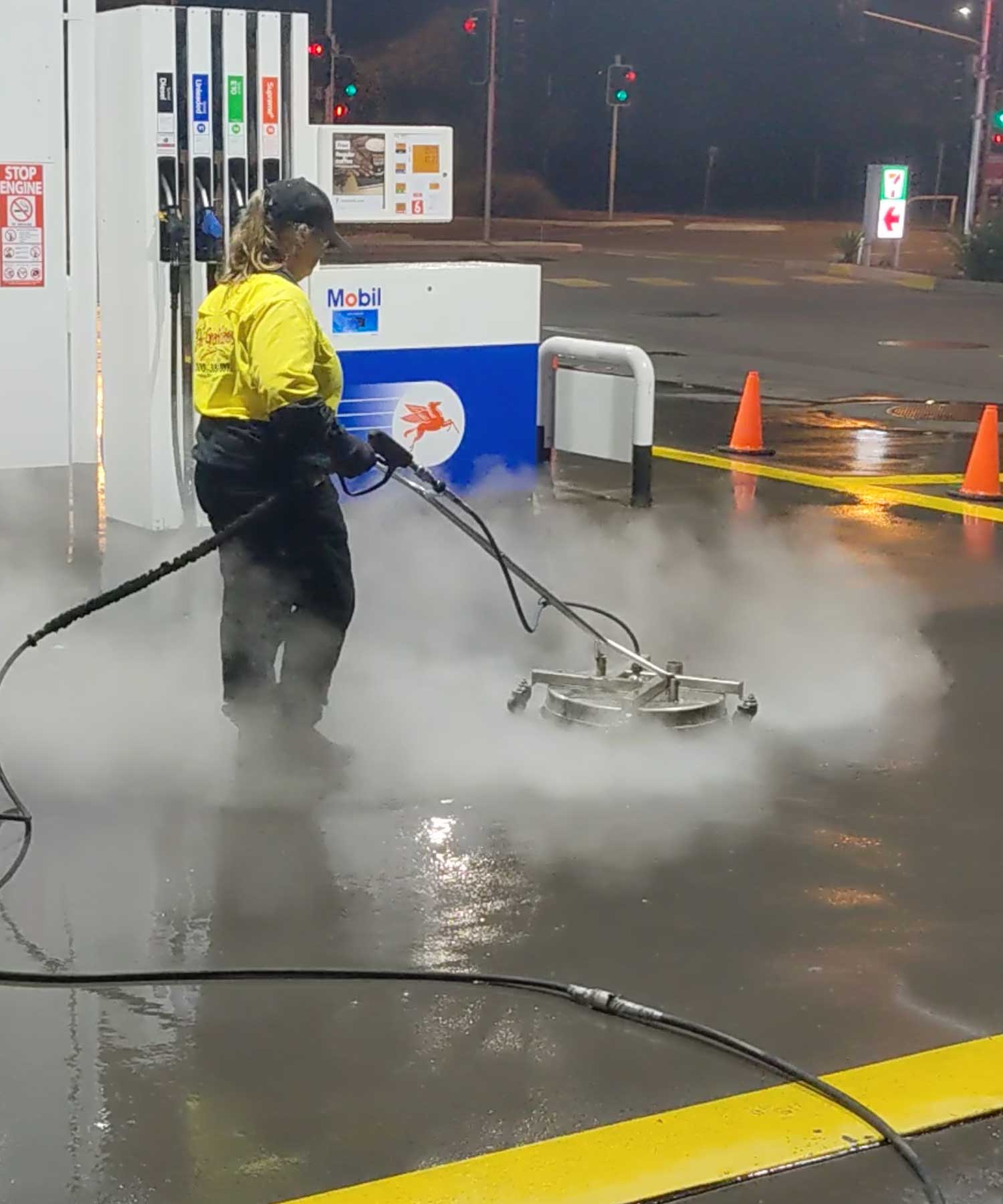
The third stage is recovery — the suspended oil and cleaning solution are drawn back to the surface of the concrete through the same capillary action that originally drew the oil in, but now working in the reverse direction. Once at the surface, the recovered oil and treatment solution are removed by hot water pressure washing using a spin jet system, which delivers thorough coverage and the combination of heat and pressure needed to flush the recovered contamination completely from the surface.
The dwell time allowed between application and pressure washing is a critical variable in this process. The treatment solution needs adequate time to work through all three stages — particularly for older, more deeply set staining where the oil has had time to polymerise and bond within the pore structure. Our technicians manage dwell time based on the oil type, stain age, and surface condition, adjusting the approach for each job rather than applying a fixed protocol regardless of the specific contamination.
For severe or very old staining, the three-stage process may need to be repeated. The first treatment cycle addresses the most accessible contamination, and subsequent cycles reach deeper into the residual staining left after the first pass. Our technicians assess the result after each treatment and advise on whether repeat treatment is likely to produce meaningful further improvement.
Wastewater: An Environmental Responsibility
Oil-contaminated wastewater — the runoff from pressure washing an oil-treated surface — is a regulated waste stream under Australian environmental legislation. Allowing oil-contaminated water to enter stormwater drains is an environmental offence with genuine consequences, and it is an aspect of oil stain removal that DIY approaches rarely address.
Where site conditions allow, The Stain Eaters captures and responsibly disposes of all oil-contaminated wastewater as a standard part of the treatment process. This is not an optional extra — it is part of how the job is done properly and in compliance with environmental obligations. The wastewater capture requirement and the site conditions that affect it are assessed before work begins on every job.
The Surfaces and Environments Where This Matters
Oil stain removal from porous concrete is relevant across a wide range of residential and commercial environments, and the stakes around the problem vary significantly by context.
For residential driveways and garage floors, oil staining is a cumulative problem that builds over time. Vehicles that drip oil regularly — older cars, vehicles with minor seal leaks, classic vehicles that are maintained at home — deposit oil in the same spots repeatedly, creating staining that deepens with each occurrence. The driveway is one of the most visible features of a residential property, and persistent oil staining affects presentation and, for properties on the market, buyer perception.
For commercial car parks, the combination of high vehicle volume, diverse vehicle types, and large surface areas makes oil contamination a constant and significant maintenance challenge. Oil staining on car park surfaces creates slip hazards with liability implications, particularly when wet — oil-contaminated concrete is dramatically less slip-resistant than clean concrete. Regular professional oil stain treatment as part of a planned maintenance program is a practical risk management measure as much as a presentation one.
For petrol station forecourts, fuel and oil contamination is an inherent operational reality. The combination of vehicle traffic, refuelling activity, and the physical characteristics of forecourt surfaces — which are typically concrete or asphalt in high-drainage configurations — means that contamination management is a compliance requirement, not just an aesthetic consideration. Forecourt operators have specific obligations around the management of fuel and oil contamination under state environmental regulations.
For factory floors, workshop surfaces, and industrial hardstands, oil contamination from machinery, vehicles, and operational processes creates both safety and compliance challenges. Industrial floors with significant oil contamination require treatment approaches that address both the contamination and the compliance obligations around wastewater management.
Acting Quickly: The Most Important Variable
Everything in this post points to the same conclusion — the sooner oil staining is treated professionally, the better the result and the lower the cost.
Fresh oil that has been on a concrete surface for minutes or hours is dramatically more treatable than oil that has been in place for days, weeks, or months. The penetration is shallower, the oil is less polymerised, and the three-stage treatment process has a much easier task to perform. In some cases, very fresh contamination can be significantly addressed in a single treatment cycle where older staining would require multiple passes.
If an oil spill occurs and immediate professional treatment is not possible, covering the affected area with an absorbent material — sand, sawdust, or commercial absorbent granules — limits further penetration by absorbing the surface-level oil before it migrates deeper. Remove the absorbent material without scrubbing it in, and leave the surface for professional treatment rather than applying household cleaning products that risk pushing the contamination deeper.
If you have oil staining on a driveway, car park, garage floor, forecourt, or any other concrete surface — fresh or set, isolated spot or large area — get in touch with The Stain Eaters team today for a free assessment. We will identify the contamination type, assess the staining, and give you a clear picture of what the treatment process involves and what result you can expect.