
The Dirty Truth About Artificial Grass — and How to Fix It
Artificial grass has become one of the most popular backyard upgrades in Australia, and it is easy to understand why. No mowing, no watering, no muddy patches after rain, and a lawn that looks consistently green and tidy regardless of the season. For households with dogs, it has the added appeal of being durable and easy to hose down — or so the thinking goes.
The reality of artificial grass and pet ownership is a little more complicated than the brochure suggests. Because while synthetic lawns are genuinely low maintenance in many respects, they have a particular vulnerability that natural grass does not share — and it is one that becomes increasingly difficult to ignore the longer it goes unaddressed.
Dog urine on a natural lawn drains through the soil, where it is diluted, dispersed, and broken down by soil microorganisms over time. On artificial grass, that same urine has nowhere to go except into the fibres and infill material — where it sits, concentrates, and begins to create the conditions that every artificial grass dog owner eventually becomes familiar with: the smell that hits you when you open the back door, that gets worse on warm days, and that no amount of hosing down with a garden hose seems to fully shift.
That smell is not just unpleasant. It is a sign of something worth taking seriously.
What Is Actually Happening in Your Artificial Grass
To understand why pet waste on artificial grass is a genuine hygiene problem rather than just a nuisance, it helps to understand what the material actually is and how it behaves when contaminated.
Artificial grass consists of synthetic fibres — typically polyethylene or polypropylene — tufted into a backing material, with an infill layer usually made of crumb rubber, sand, or a combination of both. That infill layer is what gives the lawn its cushioning, holds the fibres upright, and contributes to the natural look and feel of the surface. It is also, unfortunately, an excellent medium for trapping and retaining organic material.
When a dog urinates on artificial grass, the liquid passes through the fibres and into the infill material, where it is absorbed and retained. Unlike soil, which has a complex microbial ecosystem that actively breaks down organic waste, synthetic infill material has no such capacity. The urine sits in the infill, concentrating over time as repeated use adds more to the same areas — because dogs, like most animals, tend to return to the same spots consistently.
As the urine breaks down, it produces ammonia and a range of other volatile compounds that are responsible for the characteristic odour. In warm weather, this process accelerates dramatically — the heat amplifies the volatility of the odour compounds and speeds up the bacterial activity that drives decomposition. The result is that a lawn that smells merely questionable on a mild day can become genuinely unpleasant on a hot afternoon.
Solid waste compounds the problem. Dog faeces removed from the surface — as responsible pet owners do — still leaves behind residue, bacteria, and organic material in the fibres and infill that contributes to the overall contamination load. And in households with multiple dogs, or where the lawn has been in place for some time without professional cleaning, that contamination load can be substantial.
Beyond dogs, residential artificial lawns are also subject to contamination from other animals — birds, possums, and other wildlife that visit suburban gardens leave droppings on the surface that contribute to the bacterial load and odour. Bird droppings in particular can accumulate in significant quantities on lawns beneath trees or near feeding areas, adding to the overall hygiene burden of the surface.
The Hygiene Reality — Particularly for Families With Children
The odour is the most obvious symptom of a contaminated artificial lawn, but it is not the only concern. Beneath the surface of a heavily pet-affected artificial lawn, bacterial colonies can establish themselves in the infill material in ways that are not visible and not addressable by surface-level hosing.
Those bacteria include organisms that are genuinely hazardous to human health — pathogens present in animal faeces that can cause gastrointestinal illness and other health issues upon contact. For households where children play on the artificial lawn — rolling around, playing on hands and knees, the way children do — the contamination of the lawn surface is a hygiene consideration that goes well beyond the inconvenience of an unpleasant smell.
This is not meant to create undue alarm. A well-maintained and regularly cleaned artificial lawn is a safe surface for children and pets alike. The concern arises when contamination is allowed to build up over time without professional treatment — and given that the contamination is largely invisible and confined to the infill layer rather than the surface, it is easy to underestimate the extent of the problem.
Regular professional cleaning that reaches into the infill material — not just washes the surface fibres — is what addresses this hygiene dimension properly. A garden hose does not have the penetration to flush the infill thoroughly. Low pressure professional washing does.
Why a Garden Hose Is Not Enough
The instinct of most artificial grass owners dealing with pet odour is to hose the lawn down. It is the most accessible response, and it does provide temporary relief — the surface is wet, the immediate odour is reduced, and the lawn looks clean.
The problem is that a garden hose delivers low-volume water at relatively low velocity, and it has no meaningful penetration into the infill layer where the contamination actually lives. What hosing achieves is surface rinsing — wetting the fibres and dispersing some of the surface-level contamination. What it does not achieve is the flushing of the infill material where urine, bacteria, and organic residue have accumulated.
In some cases, repeated hosing without proper cleaning can actually concentrate the contamination further — the water dissolves surface-level material and carries it down into the infill, adding to what is already there rather than removing it. The lawn looks clean immediately after hosing and smells tolerable while it is wet, but as it dries and warms up, the odour returns — often stronger than before because the water has redistributed and concentrated the contaminating material deeper in the infill.
This cycle of hosing and temporary relief is familiar to most pet-owning artificial grass owners, and it ends the same way every time: the smell comes back, the hosing happens again, and the underlying contamination continues to build. Breaking that cycle requires a different approach entirely.
The Stain Eaters Artificial Grass Cleaning Process
Professional artificial grass cleaning addresses the contamination problem at the level where it actually exists — in the fibres and the infill material — rather than just at the surface.
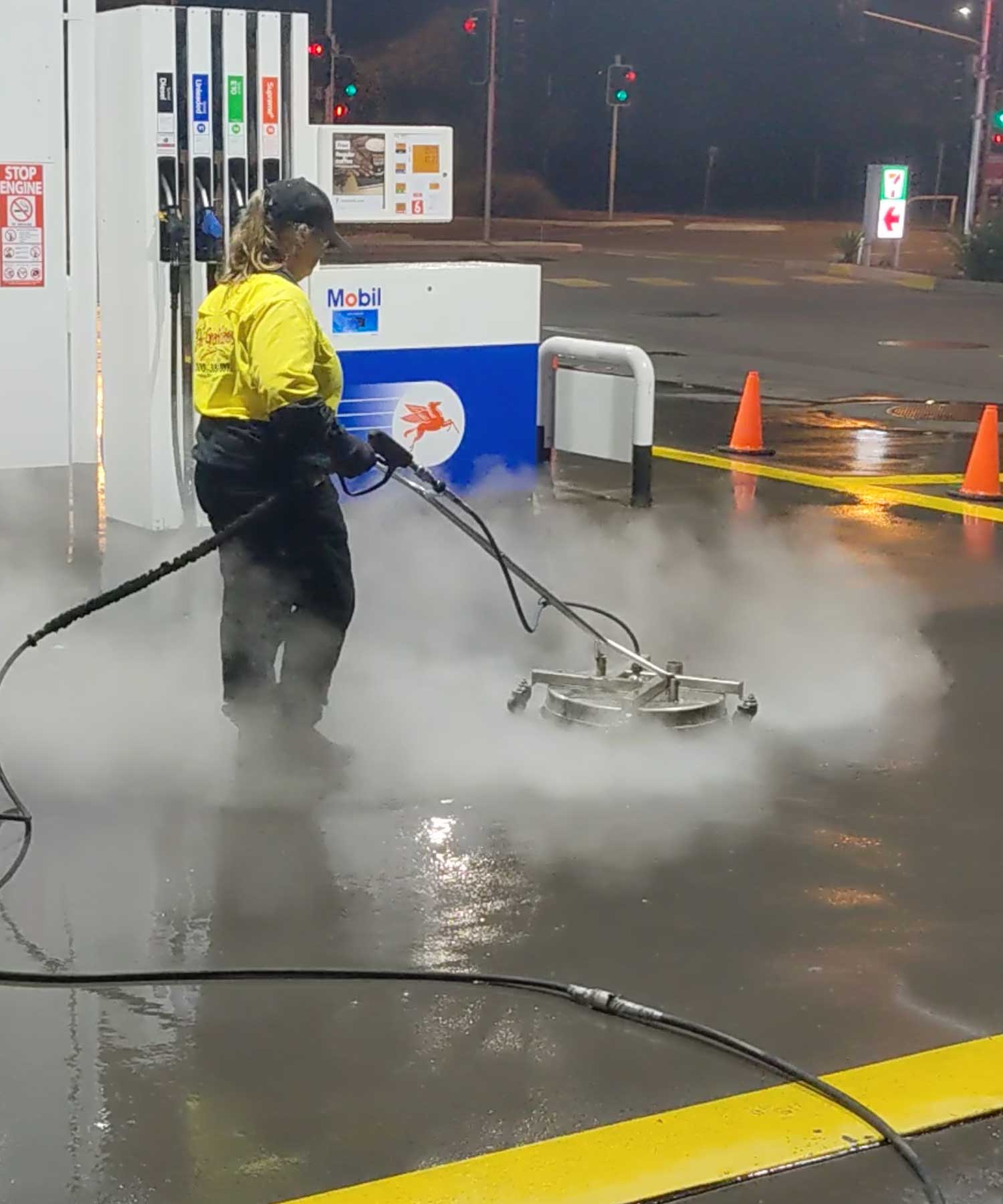
Our technicians use our custom-built pressure washing equipment set to a low pressure delivery specifically appropriate for artificial grass surfaces. The low pressure setting is important — too much pressure on artificial grass can damage the fibres, displace the infill material, and disturb the backing layer in ways that affect the performance and appearance of the lawn. Our equipment allows precise pressure calibration, and the setting used for artificial grass cleaning is designed to deliver thorough penetration into the infill without any of those risks.
The low pressure wash flushes through the full depth of the grass system — the fibres, the infill layer, and the drainage layer beneath — removing accumulated pet waste residue, bacteria, dirt, dust, and organic debris in a way that a garden hose simply cannot replicate. General dirt and environmental soiling that accumulates on any outdoor surface — tracked in on feet and paws, blown in by wind, deposited by birds and other wildlife — is cleaned away as part of the same process, leaving the full surface refreshed rather than just the pet-affected areas.
Once the washing process is complete and the surface has been flushed thoroughly, our technicians apply a specialist odour neutralising solution as the final step. This solution works by neutralising the odour-causing compounds at a cleaning solution level — breaking down the ammonia and volatile organic compounds responsible for the smell rather than simply masking them with a fragrance. The result is genuine odour elimination rather than a temporary cover-up that fades as soon as the masking agent dissipates.
The odour neutralising solution is safe for pets and children once it has dried — so the family and the dog can be back on the lawn the same day without any concern about residual product on the surface.
General Dirt and Environmental Soiling
While pet waste is the primary driver for most artificial grass cleaning jobs, it is worth noting that synthetic lawns accumulate general soiling from a range of sources that affects their appearance and hygiene even in the absence of heavy pet use.
Dust and fine particulate matter settle on the surface continuously and work their way into the infill over time, dulling the appearance of the fibres and contributing to a general griminess that becomes more obvious the longer the lawn has been in place. Leaf litter, organic debris, and decomposing plant material that is not swept or blown off the surface adds to the organic load in the infill. Bird droppings — from the neighbourhood birds that visit most suburban gardens — accumulate across the surface and contribute both to the visual appearance and the bacterial load of the lawn.
The low pressure washing process addresses all of these sources simultaneously with the pet waste cleaning, producing a result that restores the full surface to a genuinely clean and hygienic condition rather than just targeting the pet-affected areas.
When to Clean
The honest answer to how often artificial grass should be professionally cleaned depends on how many pets use the lawn, how heavily they use it, and what the weather conditions are like in your area. A single dog in a large backyard in a temperate climate makes different demands on the lawn than two large dogs in a compact courtyard in a hot Australian summer.
As a general guide, households with dogs using an artificial lawn regularly benefit from professional cleaning at least once or twice a year — more frequently if the lawn is heavily used, if the odour returns quickly after cleaning, or if you have multiple pets. Even lawns without pets benefit from an annual professional clean to address general soiling, bird and wildlife contamination, and the buildup of organic debris that accumulates over a year of outdoor use.
The most reliable indicator is your own nose. If the lawn smells when you step onto it, or when the weather warms up, or when it gets wet — it is time for a professional clean. Waiting until the smell becomes genuinely unpleasant means the contamination has already built up to a level that will require more intensive treatment to address properly.
Getting Your Lawn Back to Its Best
Artificial grass is a genuine lifestyle upgrade — low maintenance, consistently green, and hardwearing. Managing the pet waste hygiene challenge properly is what makes it a pleasure to use rather than a source of ongoing frustration.
Professional cleaning by The Stain Eaters restores your artificial lawn to a genuinely clean and sanitary condition — fibres flushed, infill refreshed, odour neutralised at the source, and the surface safe for children and pets to enjoy. It is the treatment that a garden hose cannot replicate and that your lawn, your family, and honestly your nose will thank you for.
If your artificial grass is overdue for a professional clean, get in touch with The Stain Eaters team today for a free assessment.