
Shadowing After a Paint Spill
Why Colour Lingers and How We Clear It Properly.
When a paint spill gets cleaned up, the area looks better for a while. Then the surface dries and you see it — that faint stain or “shadow” sitting in the concrete, pavers, tiles, or painted surface like a watermark. It’s one of the most frustrating outcomes for property owners and managers because it makes the site look permanently dirty, even when the mess is technically gone.
Shadowing is common after paint, dye, ink, tannin-rich liquids, rust-coloured run-off, and a range of commercial spills. And it’s rarely solved by scrubbing harder. In fact, the wrong clean-up attempt is often what locks the shadow in.
This post explains why colour lingers, what secondary staining is, and how our technicians remove shadowing to restore an even, consistent finish.
What “shadowing” actually is
Shadowing is leftover pigment or staining that remains after the bulk of a spill has been removed. It’s usually faint, patchy, and more noticeable when the surface is dry or when light hits it from an angle. On porous materials, it can look like a ghost outline. On smoother finishes, it can look like a dull haze or discolouration.
The key point is this: the visible spill was only the top layer. The stain you’re seeing now is what’s sitting in the pores, texture, or micro-scratches of the surface.
Why colour lingers: pigment lodging in porous surfaces
Concrete, grout, pavers, brick and many natural stones are porous. Even when they feel hard, they’re full of tiny voids and capillaries. When a coloured liquid or paint hits the surface, pigment can be pulled down into that structure, especially if the spill is left for even a short time.
Once pigments lodge, a quick rinse won’t reach them. Scrubbing can sometimes spread colour wider. And aggressive pressure cleaning can push pigment deeper or create a clean “ring” around the stain that makes it stand out more.
This is why shadowing is so common on bare, unsealed substrates.
Secondary staining: when the clean-up creates a new problem
Secondary staining happens when the spill is partially removed, but the cleaning process leaves a new discolouration behind. Common causes include:
- On paint or ink, wiping and re-wetting can spread diluted pigment into surrounding pores, creating a larger faded halo.
- On coloured liquids, repeated wetting and drying cycles can draw stain back to the surface, then re-deposit it slightly wider each time.
- On porous surfaces, using the wrong product can shift colour rather than lift it, leaving a more stubborn discolouration than the original spill.
This is the moment many people get stuck. The area is cleaner, but it looks uneven — and the unevenness becomes the new eyesore.
Why DIY methods often make shadowing worse
Most DIY clean-up attempts fall into one of two traps: too gentle or too aggressive.
Too gentle means the pigment is never properly lifted. The surface looks improved while wet, then the stain reappears as it dries.
Too aggressive is where damage happens. Over-scrubbing can roughen the substrate and make it grab dirt faster later. Excess pressure can etch or brighten the surface around the stain, creating a high-contrast patch that’s more noticeable than the shadow itself.
The end result is the same: a surface that looks inconsistent, which is the opposite of what you want in a public-facing area, entry zone, or commercial walkway.
How we clear shadowing and restore an even look
Removing shadowing is a treatment process, not a single step. Our technicians focus on three things: lifting the pigment, controlling the clean, and restoring consistency.
We start by identifying what caused the staining and what the surface is made from. That matters because different pigments and substrates respond differently, and the wrong approach can permanently change the finish.
From there, we use specialist treatments designed to break down and lift lodged colour, rather than just washing the surface. This is where experience makes a difference — the goal is to remove the shadow without creating clean patches, dull spots, or texture damage.
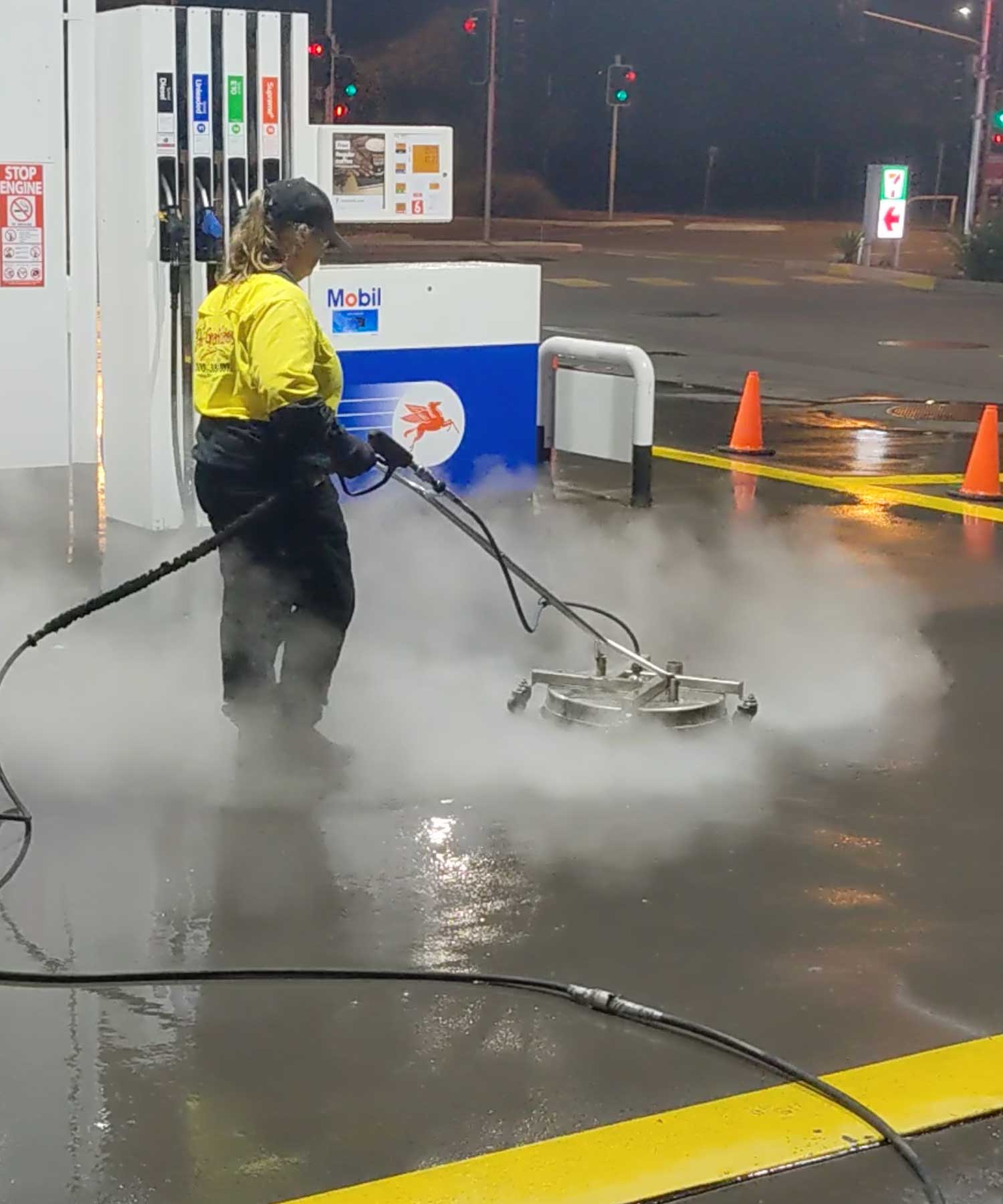
Once the stain is properly treated, we rinse and clean using our custom-built pressure washing systems to deliver hot-water under controlled pressure. Hot water helps release stubborn residues and improves the overall finish, while controlled pressure helps protect the substrate and keep the result even.
On some jobs, especially where staining has had time to lodge deeply, a second treatment cycle may be needed to pull out the remaining colour and achieve a more uniform finish. The aim is always the same: the surface should look consistent again, not “fixed in one spot”.
Where this matters most
Shadowing is especially noticeable in high-visibility areas like shopfronts, entryways, common areas, loading docks, carparks, pathways and strata walkways. These are the places where a faint stain still reads as “uncared for”, even if the site is otherwise clean.
If you’ve got a spill that’s left a stubborn ghost mark, it’s worth getting it treated properly before it becomes a permanent feature.