
Rain, Mulch, Grime: Why Concrete Paths Get So Dirty So Fast
There’s a particular kind of frustration that comes with looking down at a concrete path, driveway, or courtyard that was clean a few weeks ago and now looks like it hasn’t been touched in years. It happens more often than people expect, and it happens fast. A single heavy rain event, a run of wet weather, or even just a season of ordinary wear and tear from nearby garden beds is often all it takes to turn a light, clean concrete surface into something dull, grey, and generally unpleasant to look at.
The instinct at that point is usually to grab a broom. And the broom does something — it shifts the loose stuff, tidies up the obvious debris, makes the area look marginally better for about five minutes. But the underlying dirt, the greyish film, the ground-in grime that’s actually changed the colour of the concrete, is still there. Sweeping was never going to touch it, and understanding why is the first step to actually getting the surface properly clean.
Where All That Dirt Actually Comes From
Concrete paths and driveways cop a surprising amount of punishment from their immediate environment, and most of it goes unnoticed until it accumulates to the point where the surface looks visibly soiled.
Heavy rain is one of the most common triggers, and it’s a bit of an unfair one — the rain itself is meant to clean things, but what it actually does on a concrete surface adjacent to garden beds, lawns, or unpaved ground is wash fine sediment, soil, and organic material directly onto the concrete and leave it there as the water recedes and the surface dries. What starts as wet mud settling on the path ends up as a bonded layer of dirt sitting in the texture of the concrete once everything dries out in the sun.
Garden bed debris and general landscaping run-off add to the problem in a similar way. Mulch, soil, and plant matter naturally migrate onto adjacent paved surfaces over time — carried by rain, wind, foot traffic, or simply gravity on a sloped garden bed — and each contribution adds another thin layer to the build-up. On its own, a little bit of garden debris is barely noticeable. Accumulated over a season or two without any proper cleaning, it becomes a genuine staining problem.
There are other everyday contributors too — general seasonal grime, dust, and airborne particulate that settles on any outdoor surface over time, along with contributions from mowing and general garden maintenance nearby. None of these individually would be much to worry about, but together, especially after a heavy rain event drives everything into the surface texture and leaves it to dry, they add up to the kind of dirty, discoloured concrete that makes an otherwise tidy property look neglected.
Why a Broom Doesn’t Cut It
Here’s the thing about sweeping: it’s a surface-level solution to a problem that isn’t just sitting on the surface.
A broom is genuinely effective at moving around loose material — leaves, grass clippings, loose dirt that hasn’t bonded to anything. What it cannot do is shift dirt that has settled into the actual texture of the concrete. Concrete, even when sealed, has a surface texture with enough microscopic variation to hold onto fine particles once they’ve been driven in by rain or ground in by foot traffic. A broom bristle simply glides over the top of that texture without disturbing what’s lodged within it.
This is particularly true after rain. When sediment-laden water sits on a concrete surface and then evaporates, it doesn’t just leave a light dusting that can be swept away — it deposits the fine particulate matter that was suspended in the water directly into the surface, and as the water disappears, that material is left behind, compacted into place. The longer it sits there drying in the sun, the more entrenched it becomes, and the more resistant it is to anything short of a proper wash.
The result is a concrete surface that looks dull, patchy, and grey no matter how many times it gets swept — because sweeping was never designed to address embedded surface grime in the first place. It’s a maintenance step, not a cleaning solution.
What Actually Gets a Dirty Path Clean
Restoring a heavily soiled concrete surface properly comes down to water pressure — used the right way, with the right equipment, and matched to the extent of the problem.
For most general dirt and grime build-up of the kind caused by rain, garden debris, and everyday accumulation, pressure washing on its own is usually sufficient to get the job done. The mechanical action of pressurised water is enough to break the bond between the compacted dirt and the concrete surface and flush it away completely, restoring the original colour and texture of the concrete beneath.
For more stubborn or heavily embedded build-up — areas that have gone a long time without cleaning, or surfaces with a particularly dense layer of compacted sediment — a specialist cleaning solution can be applied first to help break down the grime before pressure washing finishes the job. It isn’t always necessary, but it’s a tool our technicians use where the situation calls for it, rather than applying the same approach to every job regardless of what the surface actually needs.
Hot water isn’t always required for this type of general dirt and grime removal either. It comes into its own for oil, grease, and more stubborn contamination, but for straightforward surface soiling from rain and garden debris, standard pressure washing typically achieves a complete result without needing to bring heat into the equation.
Cleaning Large Areas Efficiently
One of the practical challenges with dirty concrete isn’t just getting it clean — it’s getting a large area clean efficiently, without spending an entire day working across a driveway, path network, or courtyard with a standard pressure washing wand.
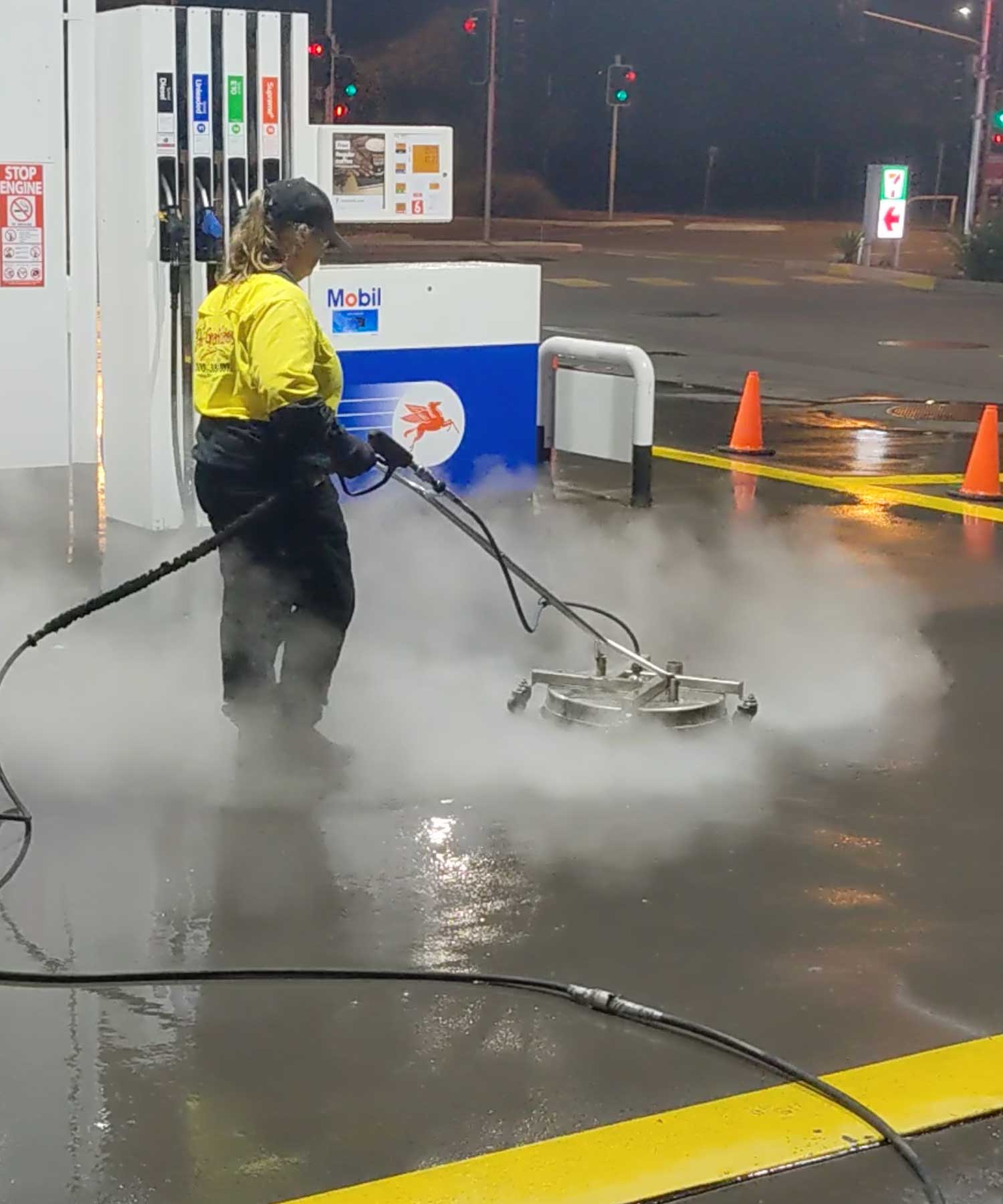
This is where our custom-built pressure washing systems make a real difference, particularly the spin jet units we use for larger surface areas. A spin jet delivers a rotating, even spray pattern across a wide section of surface in a single pass, rather than the narrow, concentrated stream of a standard lance that needs to be worked back and forth repeatedly to cover the same area. The result is faster, more even coverage across large driveways, paths, courtyards, and walkways — with a consistent clean finish across the whole surface rather than the patchy, streaky result that can come from manually working a standard wand over a big area.
For residential properties, this means a driveway or path that might take considerable time and effort to work through manually can be cleaned thoroughly and efficiently in a fraction of the time. For commercial properties with larger paved areas — walkways, courtyards, car parks, and entry paths — the efficiency gain is even more significant, and it’s the difference between a job that’s genuinely practical to schedule regularly and one that becomes a disruptive, drawn-out undertaking every time it needs doing.
Residential and Commercial: The Same Problem, Different Scale
Dirty, grime-affected concrete isn’t a problem that discriminates between property types. A residential driveway or garden path accumulates dirt from rain and garden debris in exactly the same way a commercial walkway, courtyard, or entry path does — the mechanisms are identical, even if the scale and the stakes are different.
For homeowners, a dirty path or driveway is mostly a presentation issue — it’s the first thing visitors see, and a grubby, discoloured surface makes an otherwise well-maintained property look a little tired. It’s a relatively quick and affordable fix, and one that makes a noticeable difference to the overall impression of the property.
For commercial properties, the same soiling can affect customer perception, staff amenity, and the general presentation standard of the site. A courtyard or walkway that’s accumulated a season’s worth of grime doesn’t do the business behind it any favours, particularly in customer-facing environments where first impressions matter. Regular professional cleaning as part of an ongoing maintenance routine keeps commercial paved areas presentable without the need for periodic, more intensive remediation once the problem has been left to build up over a long period.
Getting Ahead of the Problem
The most straightforward way to keep concrete paths and driveways looking their best is to address soiling before it has the chance to properly set in. A surface cleaned reasonably regularly is always a quicker, more affordable job than one that’s been left to accumulate dirt and grime over months or years, simply because there’s less embedded material for the pressure washing process to work through.
That said, if your concrete has already reached the point where sweeping clearly isn’t making a dent and the surface has that dull, greyish, patchy look that heavy rain and garden debris tend to leave behind, there’s no need to live with it. A proper professional clean will restore the surface to something much closer to its original condition, and it’s a far more straightforward job than most people expect.
If your driveway, path, courtyard, or walkway is looking worse for wear after recent weather or general build-up over time, get in touch with our team today for a free assessment.