
Pressure Washing vs Soft Washing: Which is best for canopies and façades?
Canopies and façades cop a lot—traffic film, soot, mould, algae, bird residues and mineral streaks. The challenge is choosing a cleaning method that restores presentation without bruising delicate finishes, forcing water behind joints, or dulling coatings. Here’s how we decide between pressure washing and soft washing on real sites—and why the safer choice for many canopies and modern façades is often a chemistry-led soft wash.
Two approaches, two outcomes
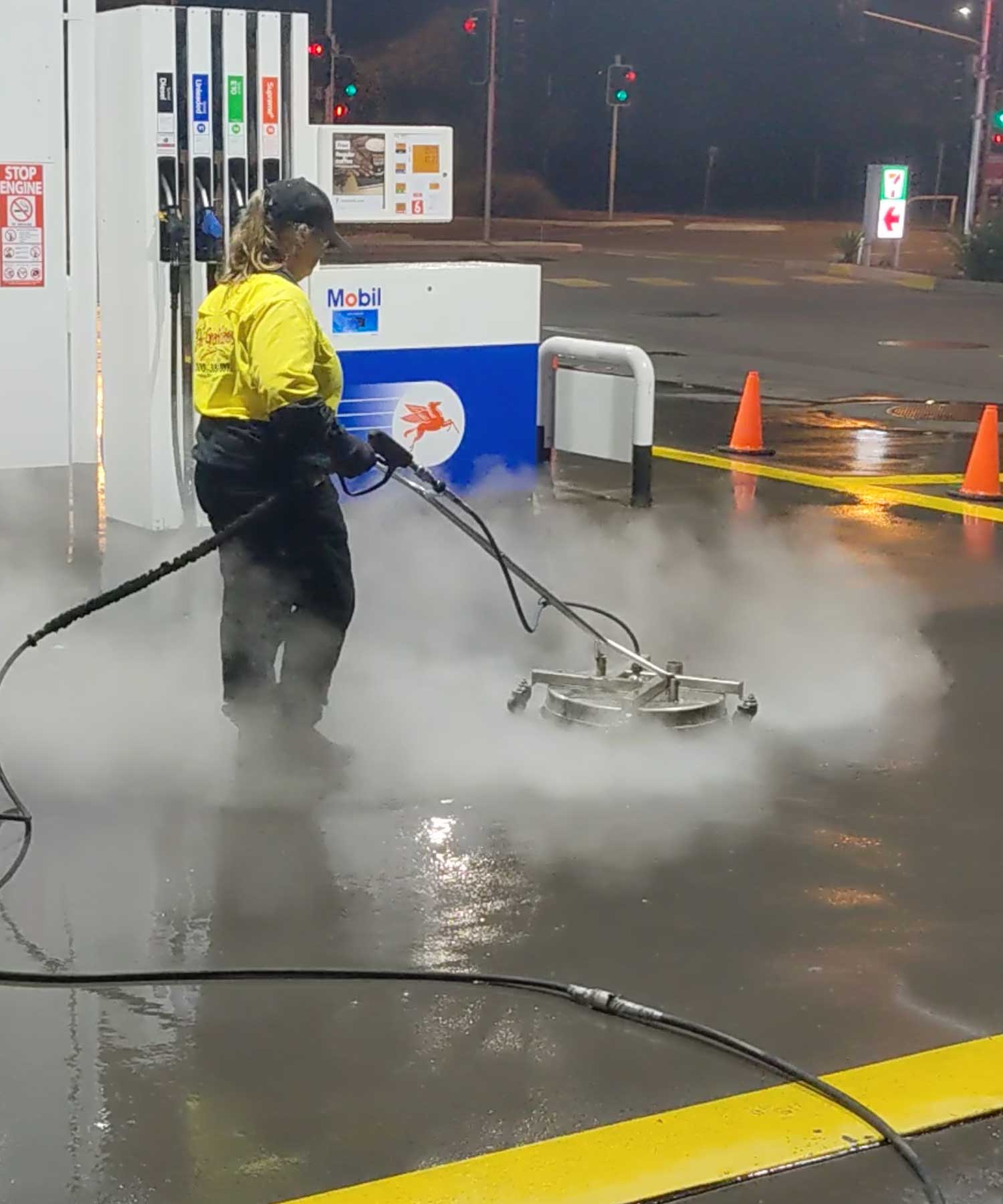
Pressure washing relies on mechanical energy (water at controlled pressure and flow) to lift and rinse away contamination. It’s efficient on robust surfaces with open texture—think concrete, brick and heavily soiled masonry—especially where build-up sits deeper in pores and joints.
Soft washing is chemistry-led. Our technicians apply specialist cleaning solutions at low pressure to dissolve organic growth, traffic film and residues, then rinse gently. It’s designed for coated or delicate materials where high pressure risks damage.
What makes canopies delicate
Many canopies are built from powder-coated aluminium and steel, polycarbonate or acrylic panels, fabric membranes (PVC/PTFE), and sealed fixings. These materials can mark, haze or lift if hit with the wrong method. Over-pressure can drive water into seams, wet electrical signage, or leave lap marks and “tiger striping”. For most canopies, a soft wash is the safer default: targeted chemistry at low pressure, controlled dwell times and a measured rinse to protect coatings, lenses, seals and adhesive edges.
Facades: matching method to material
- Render and painted masonry: Soft wash is usually best. Low pressure preserves texture and colour while the chemistry removes mould, algae and city grime.
- Aluminium composite panels (ACP), Colorbond and other coated metals: Soft wash protects the factory finish and avoids gloss burn or bloom.
- Brick, precast and concrete: When contamination sits deep (soot, oily film, mineral build-up), controlled pressure washing is appropriate. Here we use our custom-built pressure washing systems under controlled pressure to flush residues from the surface without scouring the substrate.
- Stone and tile façades: Approach depends on porosity and condition. Often a soft wash first, with selective controlled-pressure rinsing where needed.
How we choose—step by step
Every job starts with identification: substrate, coating, contaminant and access. Our technicians test a small, discreet area, then set the plan. On delicate finishes, we apply specialist cleaning solutions at low pressure to dissolve growth and traffic film, set dwell times to suit the contamination, and rinse gently for a clean, even result. On sturdier materials, we combine the right chemistry with our custom-built pressure washing systems under controlled pressure to clear deeper build-up efficiently.
Common mistakes we avoid
- Using pressure on the wrong surface: Bruised render, lifted decals, water pushed behind panels.
- Harsh cleaners at the wrong strength: Etching, bleaching and patchy gloss.
- One-speed cleaning: Ignoring changes in substrate across a single façade (e.g., coated metal next to precast) and marking the transition.
What you can expect on site
We plan around tenants and trading, set sensible work zones, and clean methodically so colour and sheen read consistently from ground level. For long canopy runs and multi-storey façades, our purpose-built Surface Restoration Vehicles give us reach and efficiency—onboard water and long hose runs mean less disruption and faster turnarounds.
If your canopy or façade looks tired—or previous cleans have left streaks or dull patches—ask us for an assessment. We’ll match the method to the material and bring the presentation back, safely.