
Paint Spill Removal on Concrete
Why Acting Fast and Getting the Treatment Right Makes All the Difference.
There is a particular sinking feeling that comes with knocking over a tin of paint on a concrete surface. Whether it happens during a weekend painting project at home, on a commercial construction site, or as the result of an accident during delivery or transport, the instinct in that moment is to deal with it quickly — and that instinct is entirely correct. What matters just as much as speed, however, is what you do next. Because paint on concrete is not a single problem with a single solution, and the wrong response can make a manageable spill into a significantly more difficult and expensive one.
Understanding why paint behaves the way it does on concrete, why different paint types require different treatment approaches, and why the clock genuinely matters from the moment of the spill — that is the foundation of dealing with paint on concrete properly.
What Paint Does to Concrete
The challenge with paint on concrete comes back to the same fundamental property of concrete that makes oil stains and rust stains such persistent problems — porosity. Concrete is not the solid, impermeable surface it appears to be. At a microscopic level it is full of tiny interconnected voids and capillaries that draw liquids inward through capillary action, and paint — particularly in its wet state — is a liquid that exploits that porosity readily.
When paint contacts a concrete surface, it begins penetrating into the pore structure almost immediately. The rate and depth of penetration depend on the paint type, its viscosity, the temperature, and the porosity of the specific concrete surface involved. But in most practical situations — a paint tin knocked over on a driveway on a warm Australian day, or a paint spill on a construction site hardstand — meaningful penetration is occurring within minutes of contact.
As the paint penetrates and begins to cure, it undergoes a cleaning solution transformation. The liquid paint film solidifies, the binders cross-link, and the paint transitions from a removable liquid to a bonded solid that is now partly within the concrete rather than sitting on top of it. The deeper into the pore structure the paint has penetrated before curing occurs, the more tenaciously it is held in the concrete and the more difficult and intensive the removal process becomes.
This is why the time between spill and treatment is so critical. It is not simply a matter of convenience — it is the difference between a paint spill that responds to relatively straightforward treatment and one that requires significantly more intensive intervention to address properly.
Water-Based vs Oil-Based: Why Paint Type Changes Everything
Here is the point that most property owners and facilities managers are not aware of until they encounter it — and it is the single most important variable in determining the right treatment approach for a paint spill on concrete.
Not all paint is the same, and the removal process that works effectively on one type of paint can be entirely wrong for another. The critical distinction is between water-based paints and oil or solvent-based paints, and it is a distinction that needs to be made correctly before any treatment begins.
Water-based paints — acrylic, latex, and most modern interior and exterior paints — use water as the primary carrier for the pigment and binder. When wet, they are water-soluble, which means that fresh water-based paint on concrete can often be addressed effectively with hot water pressure washing alone, provided treatment begins promptly while the paint is still in its wet or recently applied state. The hot water breaks down the water-soluble paint film and flushes it from the concrete surface and pore structure before curing has had the opportunity to lock it in place.
The window for this approach is time-sensitive. Water-based paint that has had adequate time to cure — particularly in warm, dry Australian conditions where curing can occur relatively quickly — is no longer water-soluble in the same way and requires a different approach. But for fresh water-based paint treated promptly, hot water pressure washing is an effective and efficient solution.
Oil and solvent-based paints are a fundamentally different proposition. These paints use oil or cleaning solution solvents as the carrier rather than water, and they are not water-soluble at any stage of their curing process. Applying hot water pressure washing to an oil or solvent-based paint spill on concrete does not break down the paint — it disperses the surface layer of the spill while the paint continues to cure and bond within the pore structure beneath. The visual result suggests progress while the underlying problem is actually being compounded.
Effective removal of oil and solvent-based paint from concrete requires a specialist cleaning solution specifically formulated to break down the paint chemistry and release the bond between the paint and the concrete substrate. That solution is applied first, allowed appropriate dwell time to work on the paint, and then followed by hot water pressure washing to flush the broken-down material from the surface. Skipping the specialist solution step and going straight to pressure washing produces an incomplete result on oil and solvent-based paints — regardless of the pressure or temperature of the water used.
This is why paint type identification is the first step in every paint spill removal job our technicians attend. Getting that assessment right at the outset is what determines whether the treatment is appropriate for the specific spill being addressed — and what separates a professional result from a DIY attempt that makes the problem harder to resolve.
The Curing Clock: Why Every Minute Counts
The relationship between time and removability in paint spill situations is not linear — it is a curve that drops off sharply as curing progresses, and then flattens into a much harder removal scenario once curing is complete.
In the very early stages of a spill — paint that has just contacted the surface and is still fully wet — the paint is at its most removable. The penetration into the concrete pore structure is shallow, the paint has not begun to cross-link and solidify, and the treatment required is at its least intensive. This is the window where prompt professional treatment produces the best result with the least intervention.
As time passes and curing progresses, that window closes. Partially cured paint is harder to address than fully wet paint. Fully cured paint is harder still — the binders have cross-linked into a solid film, the paint has bonded to the concrete at the depths it has penetrated, and the specialist cleaning solution needs to work harder and longer to break down the cured film and release it from the substrate.
For large spills covering significant surface areas — a paint tin that has rolled and emptied across a driveway, or a construction site spill that has spread across a concrete hardstand — the rate at which the exposed paint cures can vary across the spill area, with thinner areas at the edges curing faster than the thicker central deposit. That variability means the treatment approach may need to be adjusted across different parts of the same spill.
The practical message is simple: if paint has spilled on concrete, the right response is professional treatment as quickly as possible — not waiting to see if it dries in a way that makes it easier to deal with, and not attempting a DIY clean-up that is unlikely to produce a complete result and may make the professional treatment harder.
What Happens When You Get It Wrong
It is worth being direct about the consequences of incorrect paint spill treatment on concrete, because they are genuinely problematic and more common than most people expect.
The most frequent mistake is pressure washing an oil or solvent-based paint spill without prior specialist solution treatment. As described above, this disperses the surface paint without breaking down the paint that has penetrated into the concrete, and the pressure can actually drive the material further into the pore structure. The result is a ghost — a diffuse, spread stain of partially driven paint that is more deeply embedded in the concrete than it was before the pressure washing attempt.
Scrubbing paint on concrete — another common first response — has a similar effect. The abrasive action removes loose surface paint while spreading and pressing the remaining material into the concrete texture and pore structure. On textured or broom-finished concrete surfaces, scrubbing can work paint into the texture grooves in a way that makes complete removal significantly more difficult.
Applying the wrong cleaning product — a general-purpose household cleaner, a water-based degreaser, or a product not formulated for the specific paint type — produces at best a marginal result and at worst a surface interaction that changes the state of the paint in ways that complicate subsequent professional treatment. Some products react with paint films in ways that harden or alter them, making the specialist solution treatment less effective than it would have been on the undisturbed spill.
The cost implication of these mistakes is real. Paint that has been driven deeper into concrete by incorrect treatment requires more intensive specialist solution application, longer dwell times, and sometimes multiple treatment passes to address. The additional time and product required to deal with a spill that has been incorrectly treated first can significantly exceed the cost of professional treatment applied correctly to the original spill.
Deliberate Paint Vandalism: The Same Problem, Different Origin
It is worth briefly acknowledging that not all paint on concrete arrives by accident. Deliberate paint dumping — buckets of paint thrown across driveways, paths, building entries, or hardstand areas — is a form of vandalism that presents exactly the same removal challenge as an accidental spill, and requires exactly the same professional treatment process.
The paint does not know whether it was spilled accidentally or thrown deliberately, and neither does the concrete. The penetration, the curing, and the removal requirements are identical. The same paint type assessment, the same specialist solution treatment for oil-based products, the same hot water pressure washing process — and the same urgency around prompt treatment before the paint cures more deeply into the substrate.
For commercial property managers and body corporate operators dealing with deliberate paint vandalism, the response is the same as for any other paint on concrete situation: professional treatment as quickly as possible, with the right approach matched to the specific paint type.
The Stain Eaters Removal Process
When our technicians arrive at a paint spill job, the process begins with an assessment — identifying the paint type, the extent of the spill, the curing state of the paint, and the condition of the concrete surface. That assessment drives everything that follows.
For water-based paint treated promptly, hot water pressure washing is applied to flush the water-soluble paint from the surface and pore structure while it remains in a removable state. The combination of heat and pressure is more effective than cold water alone at breaking down the wet paint film and extracting it from the concrete.
For oil and solvent-based paint, a specialist cleaning solution formulated to break down the specific paint chemistry is applied first. The solution is allowed to dwell for the time required to penetrate the paint film and release its bond with the concrete substrate — longer dwell times for more cured or more deeply penetrated paint. Hot water pressure washing then completes the removal, flushing the broken-down material from the surface.
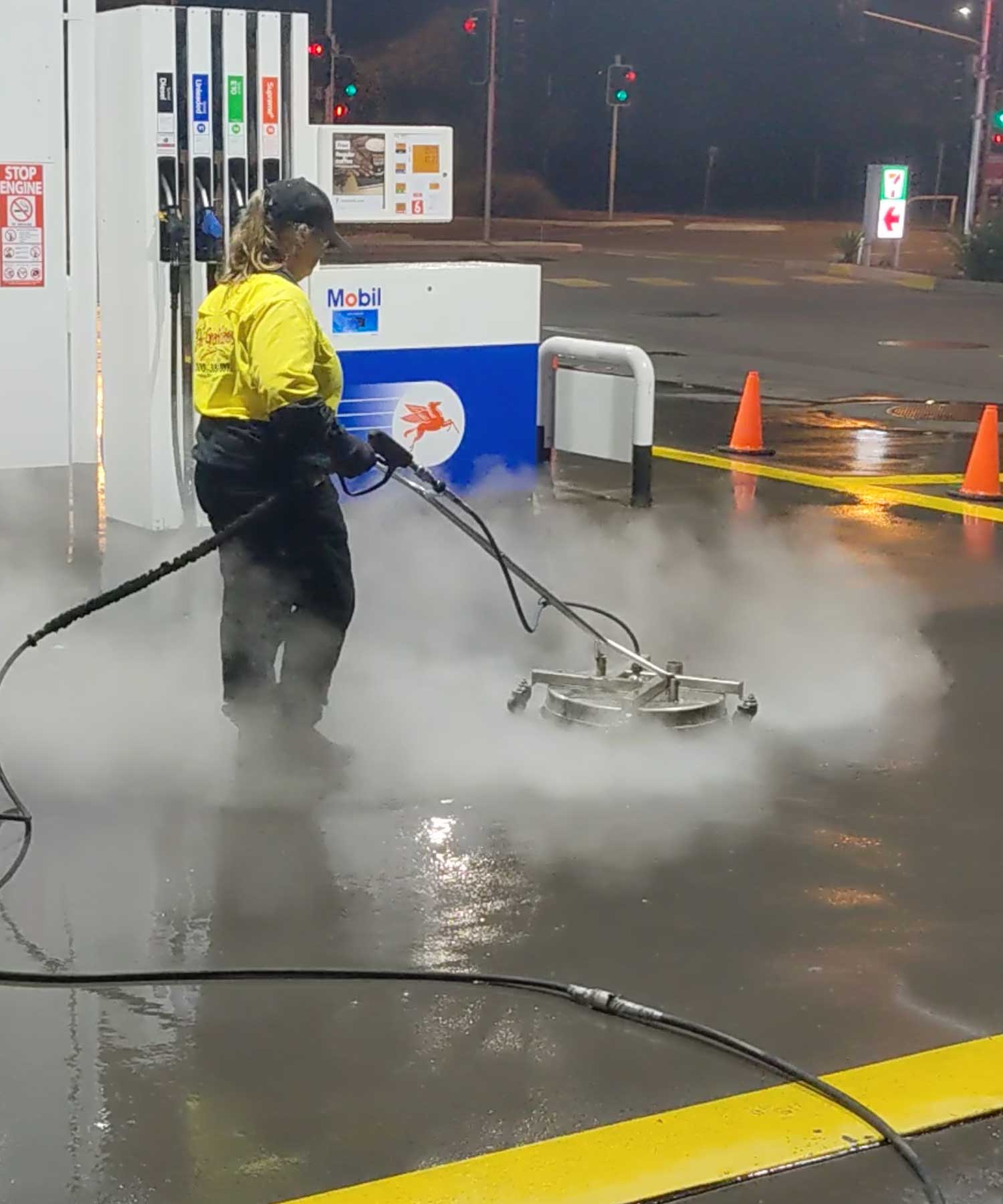
For both paint types, our custom-built pressure washing equipment delivers hot water at carefully controlled pressure — effective enough to achieve thorough removal without causing surface damage to the concrete. The result is a concrete surface that is properly cleaned rather than simply having the visible paint dispersed by pressure.
All wastewater from the pressure washing process is captured and disposed of responsibly where site conditions allow — paint-contaminated water is not something that should be entering stormwater drains, and responsible disposal is part of how the job is done properly.
Prevention: What You Can Do While Waiting for Help
If paint has just spilled on your concrete and you are waiting for professional treatment, there are a few things you can do that will help rather than hinder the outcome.
For a large spill that is still spreading, containing it with an absorbent material — sand, sawdust, or commercial absorbent granules — reduces the area the paint reaches before treatment begins. Apply absorbent material around the edges of the spill to slow the spread, and avoid walking through the paint or spreading it further.
Do not attempt to scrub, pressure wash, or apply household cleaning products to the spill before professional treatment. As discussed, these approaches are unlikely to produce meaningful improvement and may make the professional removal harder. Leave the paint as undisturbed as possible and let the technicians assess it in its current state — an undisturbed spill is always easier to treat than one that has been partially worked over with the wrong approach.
Contact The Stain Eaters as soon as possible. The sooner treatment begins, the shallower the paint penetration and the more complete the result. If you can only do one thing from the moment paint hits your concrete, making that call is it.
Get in touch with our team today for a free assessment.