
Graffiti on Public Utilities
How We Remove It Properly — Even When There’s No Power or Water on Site.
Most graffiti removal jobs happen in accessible urban environments — commercial buildings, retail strips, car parks, boundary walls — where power and water are readily available and the logistics of getting a professional team on site are straightforward. But a significant and often overlooked category of graffiti vandalism happens somewhere quite different: in parks, reserves, and public open spaces, on the utility structures, amenity buildings, and infrastructure assets that service those environments.
Pump sheds. Monitoring stations. Storage structures. Electrical enclosures. Amenities buildings at the edge of a sporting ground. These structures share a set of characteristics that make them both consistent graffiti targets and logistically challenging removal jobs. They are typically located away from the main pedestrian areas of the parks they serve. They have limited natural surveillance. They are often not checked or reported on for days or weeks after a vandalism incident. And they frequently have no mains power or water connection anywhere nearby.
The result is a category of graffiti problem that many removal operators simply cannot address properly — because without water and power on site, the equipment and process required for professional graffiti removal is not available. The Graffiti Eaters is set up differently.
Why Public Open Space Infrastructure Gets Tagged
Utility structures and infrastructure assets in parks and public open spaces are among the most consistently targeted surfaces for graffiti vandalism in Australia, and the reasons are directly related to the characteristics of the environments they sit in.
Isolation is the primary factor. A utility shed at the edge of a park, set back from the main path network and surrounded by vegetation, presents a surface that is effectively unsupervised for most of the day and virtually unmonitored at night. The combination of accessibility — these structures are rarely secured in a way that prevents approach — and low surveillance creates exactly the conditions in which graffiti vandalism is most likely to occur and least likely to be immediately detected.
The surfaces themselves are attractive targets. Colorbond and painted metal cladding — the most common finish on utility structures in public open spaces — provides a smooth, paint-receptive surface that spray paint adheres to readily and that shows tags with high visual clarity. From a vandal’s perspective, a clean, light-coloured metal shed in a quiet park setting is an almost ideal canvas.
And these structures tend to be in locations where the Broken Windows dynamic plays out with particular force. A utility shed in a remote corner of a park that gets tagged and is not promptly cleaned signals clearly — to anyone who passes it — that this location is not actively monitored and that vandalism will not be acted upon quickly. That signal invites further tagging, often by different people, and the accumulation of graffiti across successive incidents creates a visual environment that compounds the perception of neglect and disorder in what should be a well-maintained public space.
For councils and public land managers, the consequence extends beyond the individual structure. A graffiti-covered utility shed visible from a walking track or recreational area degrades the experience of the broader park or reserve, affecting community perception of the space and undermining the investment made in maintaining it as an attractive public amenity. The cost of graffiti in public open spaces is not just the cost of removal — it is the cost to community wellbeing and public space amenity that persists for every day the graffiti remains visible.
Colorbond and Painted Metal: The Specific Challenge
The utility structures in public open spaces are most commonly clad in Colorbond steel or similar factory-painted metal sheeting — a material that is durable, weather-resistant, and well suited to the outdoor environments these structures inhabit. It is also a material that requires careful handling when graffiti needs to be removed from it.
Colorbond’s protective performance comes from its factory-applied paint system — a multi-layer coating that provides corrosion resistance, UV stability, and the colour finish that identifies the product. That paint system is what graffiti is applied to, and it is what the removal process needs to protect while lifting the graffiti from the surface.
The critical point about Colorbond and factory-painted metal surfaces is that the wrong cleaning approach — incorrect specialist cleaning solutions that are incompatible with the paint chemistry, or abrasive cleaning methods that physically damage the finish — can compromise or destroy the protective coating in the process of removing the graffiti. A surface that has had its factory paint system damaged by incorrect removal is a surface that has lost its corrosion protection and its colour integrity, and rectifying that damage requires repainting rather than cleaning.
Professional graffiti removal from Colorbond and painted metal surfaces uses specialist cleaning solutions specifically selected for compatibility with factory paint systems — solutions that target the graffiti medium and release it from the surface without attacking the coating beneath it. The application is by hand, giving the technician complete control over the treatment and ensuring the solution contacts the graffiti and not the surrounding undamaged surface more than necessary.
The profiled nature of Colorbond sheeting — the ribbed or corrugated geometry that characterises the material — adds a practical dimension to the removal challenge. Spray paint follows the profile of the sheeting, wrapping into the ribs and recesses in a way that means surface-only treatment misses the paint deposited in the profiles. Hand application with appropriate tools that work the specialist cleaning solution into the profile geometry is what addresses the full surface of the tag rather than just the flat-facing plane.
The Remote Location Challenge — and How We Solve It
Here is where the logistics of graffiti removal in public open spaces become genuinely interesting — and where The Graffiti Eaters’ capability differs meaningfully from many other removal operators.
Standard graffiti removal practice assumes a degree of infrastructure access that simply does not exist at many public open space locations. Water connection for the rinsing and pressure washing steps of the removal process. Power connection for heated water systems and equipment operation. In a commercial streetscape or an industrial estate, these resources are typically accessible within a short distance of any job site. In a park, a reserve, a riparian corridor, or a remote recreational area, they may be entirely absent.
For a removal operator without self-contained infrastructure capability, a remote location without power and water is a location where the job either does not get done properly or does not get done at all. The cleaning solution can be applied by hand without power or water — but the rinsing and flushing steps that complete the removal process and leave the surface clean cannot be carried out without a water supply and the equipment to deliver it effectively.
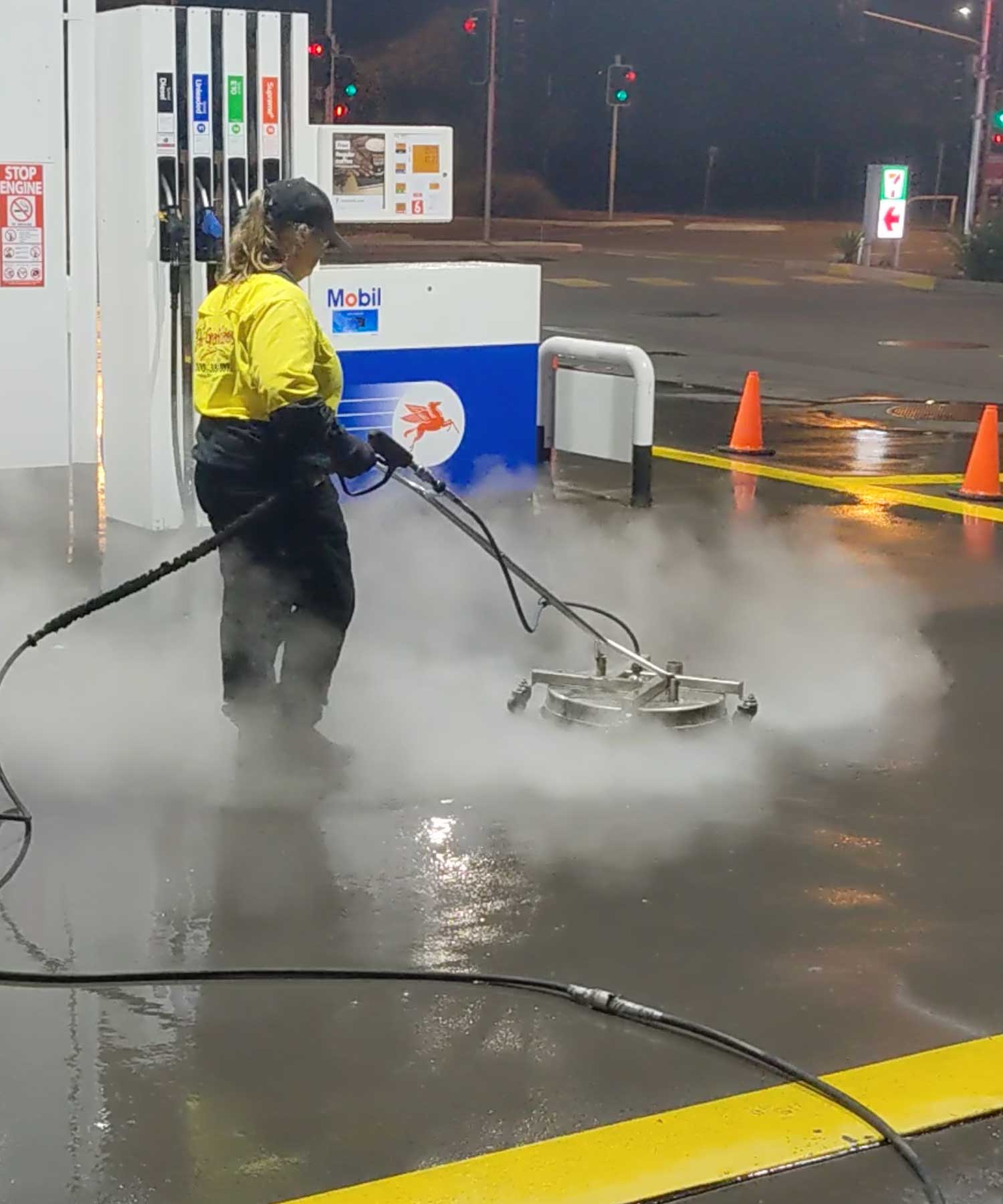
Each of The Graffiti Eaters’ surface restoration vehicles carries up to 1,000 litres of water on board, along with onboard generator power that runs all the equipment required for a complete professional removal job. The team arrives at the site fully self-contained — water, power, specialist cleaning solutions, and all necessary equipment loaded and ready — and is not dependent on any site infrastructure to complete the job properly.
This self-contained capability means that the remote utility shed in a park gets the same professional treatment as a tagged wall in a suburban commercial strip. The same specialist cleaning solution matched to the graffiti medium and the surface type. The same hand-application process with appropriate dwell time. The same rinsing and completion steps that produce a clean, residue-free surface. The location is remote, but the result is the same.
For councils and public land managers responsible for infrastructure and amenity assets across large park and reserve networks, this capability matters practically. It means that graffiti on remote assets can be addressed properly and promptly — without the delay of waiting until power and water become accessible, and without the compromise of an incomplete removal attempt that leaves residue or surface damage.
The Process on Remote Colorbond Structures
When a Graffiti Eaters team attends a remote utility structure for graffiti removal, the process follows the same assessment-led approach that applies to every job — adapted to the specific characteristics of the surface and the location.
The assessment begins with the surface — Colorbond type, paint condition, the nature and extent of the graffiti, and whether there are any areas of existing paint damage or surface vulnerability that need to be managed during the removal process. The graffiti medium is identified — spray paint is most common on these surfaces, but marker tags also occur — and the appropriate specialist cleaning solution is selected based on the medium and the surface.
Specialist cleaning solution is applied by hand to the affected areas, worked into the profiled surface geometry to ensure direct contact with all the graffiti-affected surface including within the ribs and recesses of the sheeting. Dwell time is managed based on the solution, the paint type, and the age and condition of the graffiti — fresh graffiti requires less dwell time than tags that have been curing in the sun for weeks, and our technicians make that judgement based on what the surface is presenting rather than a fixed timer.
Once the dwell period has allowed the specialist cleaning solution to break down the graffiti medium’s bond with the surface, the solution and loosened graffiti material are rinsed clear using the vehicle’s onboard water supply, delivered at the appropriate pressure for the surface. The result is a clean surface — graffiti removed, Colorbond paint system intact, and no residue remaining that would continue to affect the appearance of the structure or provide a starting point for further vandalism.
The self-contained nature of the operation means the team manages its own water and power throughout the job and removes all waste material from the site on completion — leaving the location as they found it, except for the absence of the graffiti.
Speed of Response in Remote Locations
The case for rapid graffiti removal is well established — fresh graffiti is easier to remove, and prompt removal deters repeat targeting by eliminating the signal of neglect that unaddressed graffiti creates. In remote public open space locations, the speed of response has an additional dimension that compounds both of those benefits.
Remote utility structures tend to go longer between inspections than visible urban infrastructure — which means graffiti can be in place for days or weeks before it is identified and reported. Every day it sits there, it is curing more deeply onto the Colorbond surface, making removal more intensive. And every day it is visible from nearby walking tracks, recreational areas, or access roads, it is signalling to anyone who passes that this location is an unmanaged target — an invitation to the next graffiti incident.
For councils and public land managers, building a reporting and response process that minimises the time between a graffiti incident occurring and a removal team being on site is the most effective way to manage both the removal cost and the deterrence outcome. An asset that is consistently cleaned quickly is an asset that tends to attract less graffiti over time — because the reward of visibility for the vandal is consistently denied.
Where remote assets are repeatedly targeted, anti-graffiti coating applied to the Colorbond surface after cleaning creates a barrier that makes subsequent removal faster and easier, reducing both the dwell time required and the effort of each cleaning event. For structures with a history of repeat targeting, the investment in coating is typically recovered in reduced removal costs within a small number of incidents.
A Capability Built for the Whole Job
The broader point made by the remote location capability of The Graffiti Eaters is about what professional graffiti removal should mean — complete removal, properly executed, on any surface in any location, without compromising the process because the location is inconvenient.
A utility shed in a park deserves the same professional treatment as a tagged wall in a city centre. The community that uses that park, the council that maintains it, and the agency that owns the infrastructure in it all have a legitimate interest in that standard being met. And meeting it requires a team that is genuinely equipped to work wherever the job is — not just where the infrastructure happens to be accessible.
If graffiti has appeared on utility infrastructure, public amenity structures, or other assets at remote or infrastructure-limited locations in your parks, reserves, or public open spaces, get in touch with The Graffiti Eaters team today for a free assessment.