
Don’t Let the Wrong Clean Wreck Your Walls
The Case for Soft Washing Rendered and Clad Surfaces.
There is a cleaning mistake that gets made on rendered and panelled walls all over Australia every weekend, and it is made with the best of intentions. Someone looks at their render — green with algae, streaked with grime, or just generally looking tired and dirty — and decides to get on top of it. They hire a pressure washer, crank it up, and go to work.
And then they create a problem that is significantly worse, and significantly more expensive, than the dirty wall they started with.
Rendered walls and fibre cement cladding are among the most commonly mishandled surfaces when it comes to exterior cleaning, and the consequences of getting it wrong range from frustrating to genuinely costly. Furring of the render surface. Blow-outs that compromise the integrity of the coating. Streaking that sets into the surface and proves almost impossible to shift afterwards. In worst-case scenarios, damage that exposes the substrate beneath the render to moisture, creating the conditions for cracking, swelling, and long-term structural issues.
The alternative — soft washing, done properly — produces a result that is cleaner, safer for the surface, and longer lasting. Understanding why requires a brief look at what rendered and panelled walls actually are, and why they respond so differently to cleaning than the harder surfaces most people are more familiar with.
What Makes Rendered and Panelled Walls Different
To understand why soft washing matters for these surfaces, it helps to understand what you are actually dealing with when you clean them.
Acrylic render is the most widely used render finish on Australian homes and commercial buildings built or renovated in the past few decades. It is a polymer-modified coating applied over masonry, hebel, or other substrates, and it produces the smooth or textured finish that has become the dominant aesthetic on contemporary residential and commercial buildings. Acrylic render is flexible, durable, and weather-resistant — but it is not impervious to damage, and it is considerably more vulnerable to aggressive cleaning than the brick or concrete surfaces it often replaces.
Cement render — the older, harder cousin of acrylic render — is more common on older properties and presents its own set of cleaning challenges. Less flexible than acrylic, cement render is vulnerable to moisture infiltration and surface erosion, and high-pressure water applied incorrectly can accelerate the deterioration of aged or weathered cement render surfaces significantly.
Fibre cement cladding — products like James Hardie’s range, which is ubiquitous on contemporary Australian homes — is the most common panelled wall surface our technicians encounter. It is a composite material made from cement, sand, and cellulose fibres, and it is used extensively as an exterior cladding on both residential and light commercial buildings. Fibre cement is durable and dimensionally stable in normal conditions, but it is moisture-sensitive in ways that matter enormously for cleaning. Excessive water pressure, or water forced behind panel joints and into the substrate, can cause swelling, delamination, and paint failure — problems that are expensive to rectify and entirely avoidable with the right cleaning approach.
What all of these surfaces share is a surface finish — paint, texture coat, or factory-applied coating — that sits on top of the substrate and provides both the aesthetic and the protective function. That finish is what you are trying to preserve when you clean these surfaces, and it is what high-pressure washing puts directly at risk.
What Goes Wrong With High-Pressure Washing
The damage that high-pressure washing causes to rendered and panelled surfaces is worth understanding in some detail, because it is not always immediately obvious — and by the time it becomes obvious, the damage is done.
Furring is the most common outcome of excessive pressure on acrylic and cement render. It occurs when the pressurised water stream disrupts the surface texture of the render, lifting and roughening the finish in a way that changes the appearance and texture of the surface permanently. On smooth acrylic render, furring creates a rough, abraded appearance that catches light differently and is immediately visible. On textured render, it can alter the pattern of the texture inconsistently, creating patchy areas that stand out against the undamaged surface. Furring cannot be cleaned away — it is physical surface damage that requires recoating to correct.
Blow-outs are a more severe form of surface disruption, where pressurised water penetrates beneath the render coating and forces it away from the substrate in localised areas — creating bubbles, chips, or craters in the surface. On older or weathered render where adhesion has already begun to weaken, blow-outs can occur even at moderate pressures that would be entirely safe on a newer surface. The result is a surface that needs patching and recoating before it can be repainted or refinished.
Streaking on rendered surfaces is a different kind of problem, caused not by pressure alone but by the interaction of high-pressure water with surface contamination. When pressurised water hits a contaminated surface, it can drive pigment, grime, and biological material into the render texture rather than lifting it cleanly away, or it can redistribute contamination in streaking patterns that dry into the surface. Streaks caused this way are often surprisingly resistant to follow-up cleaning precisely because the pressure has embedded them into the texture of the render.
For fibre cement cladding, the primary risks are moisture-related. High-pressure water forced into panel joints, around fixings, or through any micro-cracking in the surface coating can reach the substrate, where it causes swelling and dimensional change in the panel material. Over time, this manifests as paint failure, edge swelling, and in more serious cases, structural delamination of the panel itself. On a surface that is specifically designed to manage moisture from the outside, forcing water in from the outside under pressure is a significant problem.
What Soft Washing Actually Is
Soft washing is not simply pressure washing with the pressure turned down. That distinction matters, because the effectiveness of soft washing comes not from water pressure but from the combination of specialist cleaning solutions, appropriate dwell time, and low-pressure water delivery — and understanding that combination explains why it produces results that high-pressure washing cannot safely achieve on these surfaces.
The process begins with the application of a specialist cleaning solution formulated for the specific surface type and the specific contamination being treated. On rendered walls dealing with mould, algae, and organic biological growth — which is by far the most common reason these surfaces need cleaning — the solution is selected to break down and lift that biological material effectively without attacking the surface coating beneath it. The right solution applied to the right surface will do the heavy lifting that pressure cannot safely do on a render or cladding finish.
Dwell time is the element of soft washing that is most frequently underestimated, and it is one of the most important variables our technicians manage on every job. Once a specialist cleaning solution is applied to a surface, it needs adequate time to penetrate the contamination, break down the biological material, and work through the layers of grime and organic growth that have accumulated on the surface. Rush that process — apply solution and immediately rinse — and you get an incomplete result that leaves residual contamination behind and often requires repeat treatment. Allow appropriate dwell time and the solution does its job thoroughly, producing a cleaner result with less mechanical intervention required.
Dwell time is not a fixed quantity. It varies depending on the surface type, the cleaning solution being used, the density and depth of the contamination, and the ambient temperature and conditions on the day. Our technicians assess and manage dwell time on every job, adjusting as needed based on what the surface is telling them. It is a skilled judgement call, not a timer on a phone.
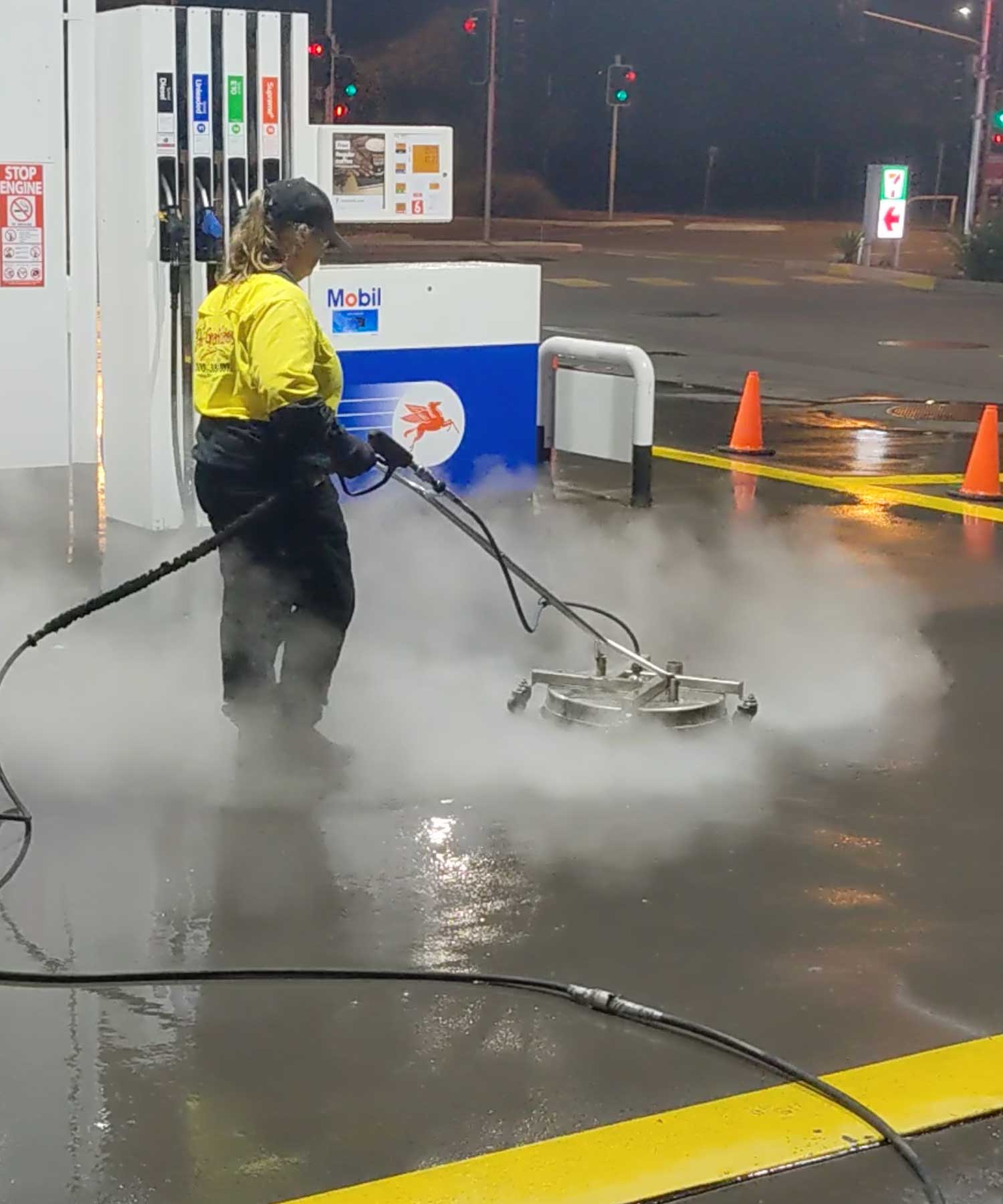
The water delivery component of soft washing uses the same custom-built equipment our technicians use across all Stain Eaters services, fitted with a soft wash attachment that delivers water and cleaning solution at low pressure. That low pressure is sufficient to apply solution evenly, assist in lifting contamination once the dwell time has done its work, and rinse the surface clean — without generating the force that causes furring, blow-outs, and moisture infiltration on sensitive substrates.
The result of that combination — the right solution, the right dwell time, and low-pressure delivery — is a surface that is genuinely clean, with biological growth and organic contamination lifted thoroughly, and the render or cladding finish completely intact.
Soft Washing for Commercial Properties and Large Facades
The case for soft washing is straightforward for residential properties, but it is equally compelling — arguably more so — for commercial operators managing larger building facades, multi-storey rendered exteriors, and commercial cladding systems.
Commercial buildings in rendered or clad finishes represent a significant asset value in their exterior presentation. A clean, well-maintained facade communicates professionalism, pride of ownership, and active management. A facade streaked with algae, darkened with biological growth, or visibly dirty creates exactly the opposite impression — and for buildings with retail tenants, office occupants, or customer-facing functions, that impression has direct commercial relevance.
The scale of commercial facade cleaning also amplifies the consequences of getting the approach wrong. Damage caused by incorrect cleaning on a residential home is expensive. The same damage across the facade of a multi-storey commercial building is a significantly larger problem, involving scaffolding, rectification work, and recoating costs that dwarf the original cleaning budget many times over.
Soft washing at commercial scale requires equipment and expertise that goes beyond what a residential operator can bring to the task. Our custom-built system is capable of handling large facade areas efficiently, and our technicians are experienced in managing the dwell time and solution application challenges that come with larger, more complex surfaces — including variation in surface condition, orientation, and contamination levels across a single building facade.
Why a Professional Assessment Makes All the Difference
One of the most important things that separates professional soft washing from DIY attempts is what happens before the cleaning begins — the assessment.
Not all rendered surfaces are in the same condition, and not all contamination responds to the same treatment approach. A freshly coated acrylic render in good condition requires a different approach to a weathered cement render that has been colonised by biological growth for several seasons. A fibre cement panel system with intact factory paint requires different handling to one where the coating has begun to chalk or fail. Getting those distinctions right before treatment begins is what determines whether the job produces a result the client is genuinely happy with.
Our technicians assess the surface condition, the substrate type, the nature and extent of the contamination, and any areas of existing damage or vulnerability before selecting their approach and beginning treatment. That assessment is not a formality — it directly shapes the cleaning solution selected, the dwell time applied, and the delivery pressure used. It is the foundation of a result that is both thorough and safe for the surface.
If you are looking at a rendered or clad exterior that needs attention — whether that is a home that has accumulated a season’s worth of algae growth, a commercial facade that is due for a proper clean, or a building that has been incorrectly cleaned in the past and needs careful remediation — get in touch with the Stain Eaters team for a free assessment. We will give you an honest evaluation of the surface condition and a clear picture of what soft washing can achieve for your property.